
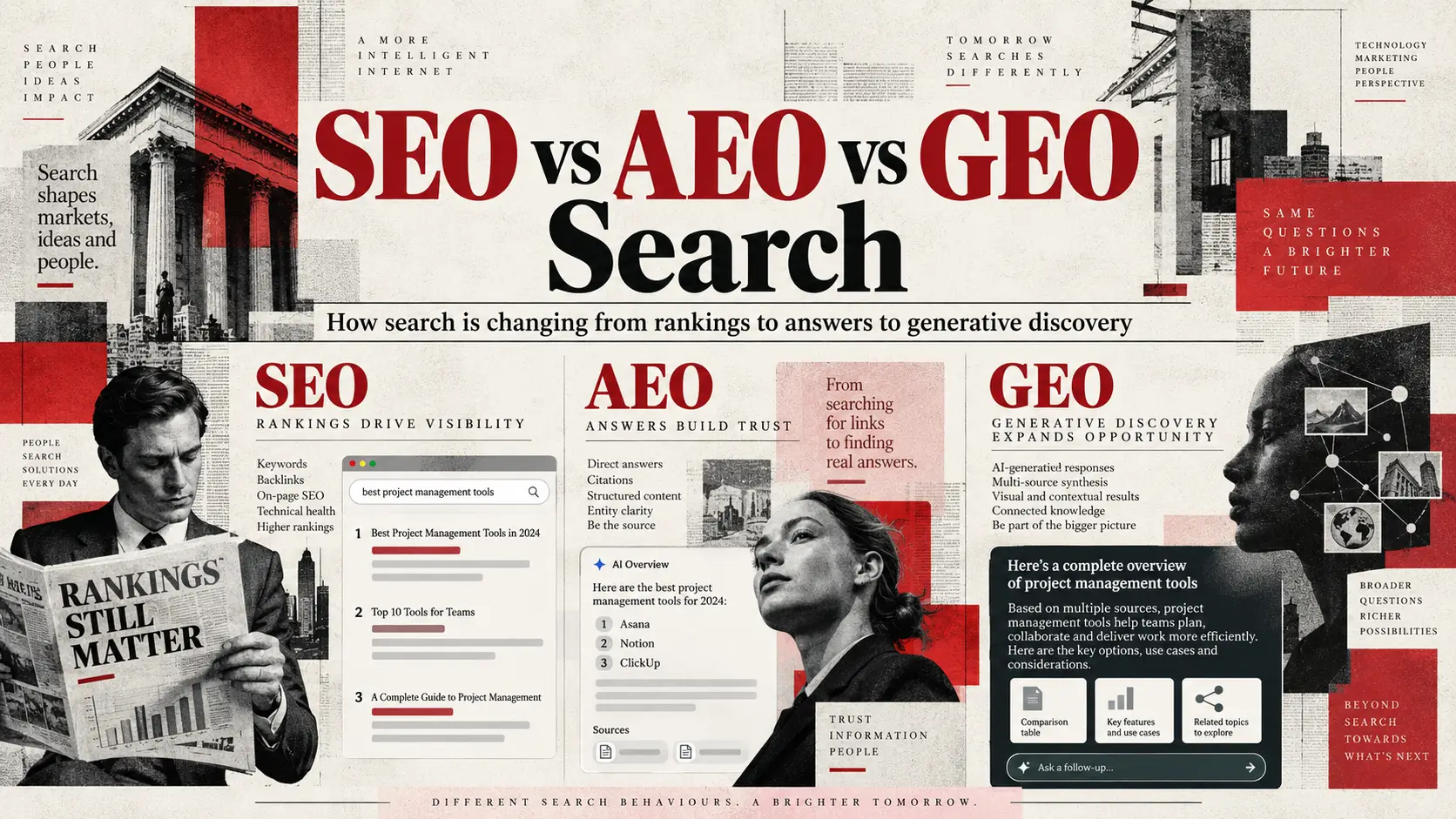
Quick Answer: SEO helps people find your website through search engines like Google. AEO (answer engine optimization) helps your content become the direct answer inside featured snippets, voice search, and AI overviews. GEO (generative engine optimization) helps AI tools like ChatGPT and Perplexity pull from your content when they generate responses. You don’t pick one. They work as layers, with SEO as the foundation.
You’ve probably run into a small pile of new acronyms. SEO. AEO. GEO. AIO. GSO. LLMO. Every week, someone coins another one.
Here’s the thing. Most of them are pointing at the same shift. Search isn’t just Google anymore. People are asking ChatGPT, Perplexity, Gemini, and Claude for answers. Google itself now shows AI-generated summaries above the blue links. And the way your content gets found (or ignored) has quietly changed.
So instead of chasing every new acronym, this guide breaks down the three that actually matter right now: SEO, AEO, and GEO. What each one is, how they differ, and how to figure out which one your business should focus on first.
Key Takeaways
- SEO gets your website found in traditional search results
- AEO gets your content picked as the direct answer in featured snippets, voice search, and AI-generated answers
- GEO gets your content used as a source when AI systems synthesize responses in ChatGPT, Perplexity, Gemini, and similar platforms
- The three approaches layer together. SEO remains your foundation, AEO extends it, and GEO builds on top
- What you prioritize depends on where your business is right now
Why the Search Alphabet Suddenly Got Longer
The shift didn’t happen slowly.
ChatGPT went from 400 million weekly active users in February 2025 to 900 million by February 2026, more than doubling in a single year. By June 2026, the ChatGPT app crossed 1 billion global monthly active users, the fastest app in history to hit that milestone. Gemini isn’t far behind, with over 900 million monthly active users as of May 2026.
That’s the demand side. Now the supply side.
Google rolled out AI overviews across most informational queries, and the impact on organic clicks has been sharp. AI overviews now trigger on roughly 48% of all tracked queries, a 58% year-over-year increase. When they appear, users click through to websites far less often. 68% of U.S. searches now resolve on Google without sending traffic to any website, and that rate jumps to 83% when AI overviews appear. Some industries have been hit even harder, with healthcare and B2B technology approaching 90% AI-overseen query coverage.
This isn’t just a traffic problem. It’s a buying behavior problem. People are researching products, comparing services, and shortlisting vendors inside AI chatbots before they ever land on a website. If your brand isn’t showing up in those conversations, you’re invisible during the part of the buying journey that matters most. I dug deeper into this in my breakdown of how generative AI is changing search.
This is why the acronym pile keeps growing. Marketers are trying to name the new game before it’s fully written.
SEO vs AEO vs GEO: How Each One Differs
Before we get into the definitions, here’s the cheat sheet.
SEO | AEO | GEO | |
Primary goal | Rank on search engines | Become the direct answer | Get cited by AI systems |
What it optimizes | Pages, keywords, backlinks | Structured answers, FAQs, schema | Entity clarity, semantic depth, authority |
Where you appear | Google’s blue links | Featured snippets, voice search, PAA boxes | ChatGPT, Perplexity, Gemini, AI overviews |
User behavior | Types keyword, clicks link | Asks question, gets instant answer | Asks in natural language, reads synthesized reply |
Success metric | Rankings, organic traffic | Snippet wins, voice pickups | Brand mentions, AI citations |
Content style | Keyword-optimized long form | Answer first, question-based | Rich, quotable, entity clear |
What is SEO?
Search engine optimization is the practice of shaping your website so it ranks well on traditional search engines like Google and Bing. Rankings depend on relevance, authority, and technical health. Better rankings mean more organic traffic. More traffic means more chances to convert.
The core levers haven’t really changed in years. You need keyword optimization that matches what people search for. You need helpful content that answers real questions. You need a clean site, speed, and mobile experience. You need meta descriptions that earn the click. You need backlinks from sites that matter. And you need to demonstrate E-E-A-T (experience, expertise, authoritativeness, trustworthiness).
SEO focuses on the long game. Rankings compound over time, and the traffic keeps coming as long as you maintain the work. If you’re a small business trying to understand the basics, I put together a full walkthrough of SEO in digital marketing that covers what actually moves the needle.
Even with AI in the mix, SEO isn’t going anywhere. Search engines still drive the majority of website traffic. And your ability to show up in AI-generated answers often depends on whether search engines understand and trust your content first.
What is AEO?
AEO stands for answer engine optimization. It’s the practice of structuring your content so that search engines and AI platforms can pull your answer and show it directly to the user.
Answer engines aren’t a separate product. They’re a mode. Google’s featured snippets are answer engines. So are People Also Ask boxes. Voice assistants like Siri and Alexa. AI overviews at the top of the search results. Every one of these pulls a piece of your content and serves it as the answer.
AEO answer engine optimization content looks different from a typical blog post. The best answer is usually at the top, within the first 40 to 60 words. Headings are written as natural language questions. Content is scannable, with bullet points and short paragraphs. Schema markup like FAQ and HowTo helps search engine crawlers understand which chunks are meant to be pulled as answers.
Here’s a simple example. If someone searches “how long does SEO take to work,” an AEO-friendly article opens with a direct sentence like “SEO usually takes three to six months to show meaningful results, depending on competition and site authority.” Google grabs that sentence and shows it as the featured snippet. Sometimes the user clicks through. Sometimes they don’t. Either way, your brand is the answer. I broke this down further in my piece on how long does SEO take.
AEO sits on top of SEO. You still need a page that ranks first before Google will pull an answer from it.
What is GEO?
GEO stands for generative engine optimization. It’s the practice of shaping your content so that generative AI tools use it when building responses for users.
Generative engines work differently from traditional search engines. They don’t hand you ten blue links. They retrieve information from many sources, combine it, and generate a new natural-language response. Your content might get cited with a link. It might get quoted without one. It might just influence the shape of the answer without any visible attribution.
The nuance matters. In AEO, if your content is picked, you almost always get a visible link. In GEO, you might get:
- A clickable citation (best case)
- A brand mention with no link (common)
- Nothing visible, but the AI response was shaped by your content anyway
That’s why GEO generative engine optimization is more about brand influence and authority than about traffic in the traditional sense. You’re playing for visibility inside AI-generated summaries, not for clicks.
What makes content GEO-friendly? A few things. Clear entity definitions so AI systems understand what your brand does and who you serve. Semantic depth, not keyword stuffing. Credible citations, data, and expert quotes AI models can trust. Fresh, updated content because AI favors recent sources. And strong E-E-A-T signals across your site.
If you want to go deeper on this, my generative engine optimization services page covers what a real GEO strategy looks like in practice, and my breakdown of SEO for LLM walks through how large language models actually retrieve content.
Are AEO and GEO the same thing? Not quite. AEO is about extraction. Your content becomes the answer, often word for word. GEO is about generation. Your content becomes one input into a new response the AI writes itself. They overlap in practice, but the technical goals are different.
What About AIO, GSO, LLMO, and All the Other Acronyms?
Short version: don’t worry about them yet.
AIO usually means artificial intelligence optimization, which some marketers use as an umbrella term for all AI-related search visibility work. GSO stands for generative search optimization, which is basically another word for GEO. LLMO means large language model optimization, again a close cousin of GEO. Some agencies push “Search Everywhere Optimization” or “agentic engine optimization” as the next thing.
Most of these describe overlapping practices with slightly different framing. A few might stick. Most won’t. The underlying work is the same: help search engines and AI systems understand your content, trust your brand, and use you as a reliable source.
How Measurement Changes
If you only track SEO metrics, you’re going to miss the whole story. Each layer needs its own set of numbers.
SEO metrics are the ones you already know. Keyword rankings, organic sessions, pages per session, conversions from organic search. Google Search Console and Google Analytics still handle most of this. Nothing new here.
AEO metrics are trickier because there’s no clean dashboard yet. Watch for featured snippet appearances in Search Console. Track which of your pages show up in People Also Ask boxes. If you have a way to test voice queries in your niche, run those checks quarterly. Position tracking tools like Ahrefs and Semrush now flag when your content wins a snippet.
GEO metrics are the newest and hardest. You’re looking for brand mentions inside AI-generated responses across ChatGPT, Perplexity, Gemini, and Claude. You want to know when your content gets cited, how often your brand appears in comparison queries, and whether AI referral traffic is showing up in your GA4 reports. Tools that track this are still early, but a few are getting solid. I compiled a working list in my post on best AI visibility tools, and I also broke down the AI search visibility metrics worth tracking each month.
The practical monthly check: are your rankings holding? Are you winning more answer boxes than last month? Are you showing up in AI responses for your top buying queries? If yes across the board, your strategy is layered right. If one is slipping, you know where to invest.
How to Know Which One to Prioritize First
Here’s where most guides on this topic go generic. Let’s be specific.
Step 1: Audit Where You Are Right Now
Open Search Console and Google Analytics. Ask three questions. Are you already ranking for your money keywords? Is your branded search volume growing or flat? Are you seeing any traffic from AI tools yet (look for referrals from chatgpt.com,perplexity.ai, or “AI” sources in GA4)?
Your answers tell you which layer to attack first. A site with no rankings shouldn’t be worrying about GEO. A site with strong rankings and flat AI visibility has room to layer up.
Step 2: Start With SEO if Your Foundation Isn’t Solid
If you’re a new site, a rebranded site, or you’ve never really invested in search, don’t skip ahead. Traditional SEO focuses on the fundamentals. Keyword research, on-page optimization, technical SEO, and content that matches search intent.
You need pages that rank before answer engines, and AI systems can even find you. Google remains the largest source of training data and citations for most AI models. Rank there first, then extend. If you’re not sure where to start, my SEO services for small businesses breakdown walks through the sequence I actually use with clients.
Step 3: Layer in AEO Once You’re Ranking
Once you have pages ranking on page one, AEO becomes the easiest win in the room. You already have the visibility. Now you’re just restructuring content so search engines pick your answer over the competition.
Start with your top ten highest traffic pages. Rewrite the opening paragraph to answer the core question in the first two sentences. Convert some of your subheadings into natural language questions. Add an FAQ section with schema markup. Watch your featured snippet appearances climb over the next three months.
Step 4: Push on GEO if Your Buyers Are Using AI Tools
Not every business needs to obsess over GEO yet. If you sell locally to older customers who still search on Google, you can wait. If you sell to marketers, developers, founders, or anyone under 40, your buyers are already using ChatGPT and Perplexity to research before they buy.
Signs GEO should be a priority: your branded searches are flat despite rising traffic (people are hearing about you elsewhere), you’re getting referral traffic from AI platforms, or your competitors are showing up in AI responses when you’re not. If any of those apply, it’s time. I covered the specific tactics in my post on ranking in AI overviews.
Which Content on Your Site Fits Which Approach
Not every page needs all three treatments. Match the tactic to the content type.
Service pages should focus on SEO plus AEO. You want to rank for commercial keywords and win answer boxes on comparison queries. Blog how-tos benefit from all three, especially those with strong educational value. FAQs are built for AEO. That’s their whole purpose. Comparison pages (“X vs Y”) do well with AEO plus GEO because they’re exactly the format AI systems love to summarize. Thought leadership and original research are pure GEO plays, since AI tools trust and cite unique data. Product pages are SEO plus AEO, with structured data doing most of the heavy lifting.
Getting this right is largely a content strategy exercise. If you want help mapping it, my content strategy services and content optimization services pages cover how I work through this with clients.
Ready to Stop Guessing and Start Growing?
Search has changed. That much is clear. But the fundamentals of good marketing haven’t. Show up where your customers are looking. Publish content that actually helps. Build authority in your space. Track what’s working and adjust.
The acronyms will keep coming. New tools will launch every quarter. But the businesses that win aren’t the ones chasing every trend. They’re the ones with a clear strategy that adapts as search evolves.
If you’re staring at this article thinking “great, but where do I even start with my site,” that’s exactly the conversation I have with most of my clients on their first call. We look at where you are, what’s working, and which layer will give you the biggest lift right now.
Let’s Talk AI Visibility
FAQs About SEO, AEO and GEO
Will AEO or GEO replace SEO?
Is GEO the same as generative AI SEO?
Can one blog post rank for SEO, AEO, and GEO?
How do I know if AI is citing my content?
Right now, tracking AI citations still involves a mix of manual checks and specialized tools. Search your top queries in ChatGPT, Perplexity, and Gemini and look for brand mentions or links. AI visibility platforms are starting to automate this, though the space is still in its early stages. I keep a working list in my post on best AI visibility tools.
Do backlinks still matter for AEO and GEO?
Related GEO/SEO Posts

How to Rank in AI Overviews
Have you noticed how Google search results display a summary of answers to your search query, much like the one below?This is a new feature introduced by Google called AI Overviews. This is part of their Search Generative Experience in Search Labs. Simply put, these...

How Much Does SEO Marketing Cost
Do you know that nearly half of U.S. shoppers start buying on search engines like Google? And SEO leads boast a 14.6% close rate, making it one of the most effective marketing channels. It’s no wonder many businesses prioritize SEO to boost website traffic and drive...

