
SEO for LLM
Best Practices and Hacks to Future-Proof Your Search Strategy
Quick answer: SEO for LLM (or LLM Optimization) is the work of getting your brand named or cited when AI tools like ChatGPT and Gemini answer questions in your industry. It is also called generative engine optimization (GEO). It builds on regular SEO with three extra habits. Write pages that answer one question completely. Earn mentions of your brand on sites AI already trusts. Track how often AI answers include you.
In this guide
- Is LLM SEO Different From Generative Engine Optimization?
- How Large Language Models Find Your Web Content
- Traditional SEO vs. LLM SEO (GEO): What Changes in Search Results
- AI Search Referrals by the Numbers
- What LLMs Prefer to Cite
- What Brands Did and What Moved
- How to Optimize Content for AI Responses
- LLM Optimization Hacks That Don’t Work
- Beyond Your Website: Reddit, YouTube, LinkedIn, and Digital PR
- How to Measure LLM Visibility and AI Search Referrals
- Optimizing for Each AI Platform
- Where LLM SEO Is Heading
Key takeaways
- AI traffic is still small. It sits around 1% of visits for most sites. It also converts up to 4 to 23 times better than Google traffic, so that 1% punches far above its weight.
- Google’s AI features mostly cite pages that already rank well. ChatGPT and Perplexity mostly cite pages that do not. You need both games.
- Being mentioned on other websites predicts AI visibility about three times better than backlinks do. YouTube mentions are the strongest signal of all.
- Short, complete answers get cited. So do massive definitive guides. The 2,000-word middle gets skipped.
- llms.txt does nothing. Adding schema alone does nothing. Both have been tested at scale.
- Only 15% of product categories have a clear “winner” in ChatGPT today. Most niches are still up for grabs.
Picture a business owner asking ChatGPT which accounting software is right for a ten-person firm. It names three brands and explains why. She never clicks anything. Two days later she Googles one of those names and lands on a pricing page. Google Analytics files it under “branded search.” The AI answer that started the whole thing leaves no trace.
That invisible moment is what SEO for LLM is about. Large language models (the technology behind ChatGPT, Gemini, and Claude) now sit between your website and a growing number of your customers. If your brand is in the answer, you win the sale before anyone visits your site. If it is missing, a competitor gets the call.
The good news is that most of this is learnable, and most of your competitors have not started. I have been tracking how AI search engines change client traffic since 2024. This guide pulls together what the 2025 and 2026 data actually says, with every source linked so you can check it yourself.
Is LLM SEO Different From Generative Engine Optimization?
You will run into a pile of acronyms the moment you start reading about this. Here is the short version. They all describe the same job: getting AI tools to mention your business.
LLM SEO (sometimes written LLMO or large language model optimization) focuses on how the AI models themselves pick which sources to trust.
Generative engine optimization, or GEO, describes the result you want. That result is your brand showing up in the answer a customer reads.
Answer engine optimization (AEO) is an older name from the days when the goal was Google’s featured snippet box.
AI SEO is the catch-all term most business owners use, and it often includes using AI tools to help with SEO work.
Term | What it focuses on | Who says it |
LLM SEO / LLMO | How AI models choose and cite sources | SEO people and software vendors |
Generative engine optimization (GEO) | Showing up inside the AI’s answer | Marketing teams and researchers |
Answer engine optimization (AEO) | Giving direct answers to specific questions | Content teams from the featured snippet era |
AI SEO | Everything above, plus using AI tools for SEO | Business owners and general press |
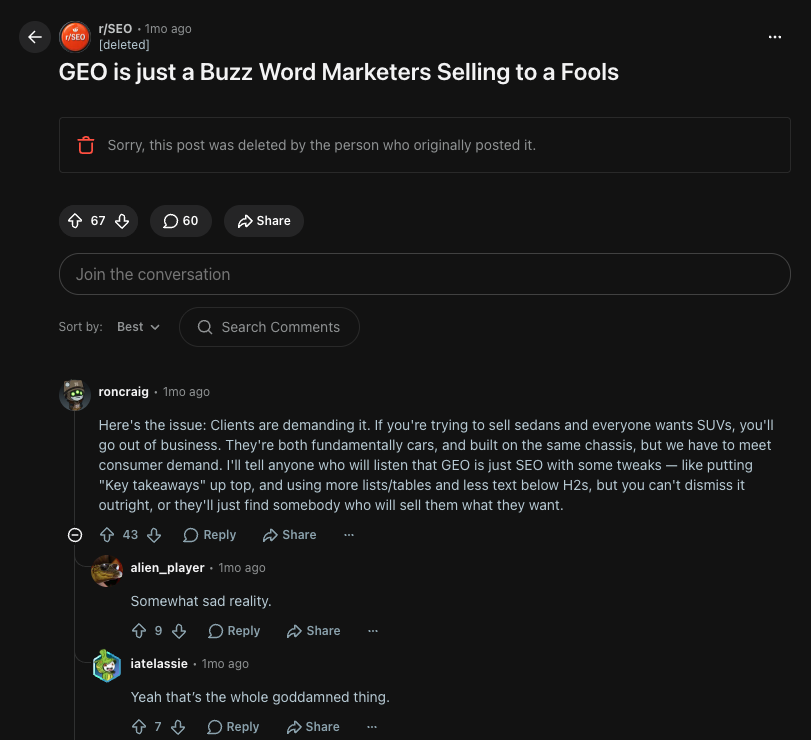

Here is the number that should matter to you more than any label. Semrush studied 50,000 brands across 1,094 product categories. Only 15.2% of categories had a clear brand that ChatGPT favors. More than half had no consistent winner at all. Whatever your niche is, there is a good chance the seat is still empty.
How Large Language Models (LLMs) Find Your Web Content
How do large language models decide what to say about you? It helps to know there are two doors into an AI answer. Most guides skip this. It explains why some tactics work and others waste your money.
Door one: what the AI already learned
Every AI model was trained on a huge pile of web pages, forums, and articles collected up to a certain date. That pile is called training data. If your brand showed up often in that pile, the model already “knows” you. It can recommend you without looking anything up. If your brand was barely there, the model has nothing to say. No amount of tweaking your own website changes what it already learned. That is why getting mentioned on other sites matters so much, and we get to that later.
Door two: a live search (retrieval augmented generation)
When a question needs fresh information, the AI runs a web search behind the scenes. Then it writes its answer from the pages it finds. The technical name is retrieval-augmented generation. You can think of it as the AI Googling for you. ChatGPT uses Bing’s search index for this. Google’s AI Overviews and AI Mode use Google’s index. Perplexity runs its own.
This happens less often than most people think. Semrush found only 34.5% of ChatGPT questions had web search turned on in February 2026. Profound looked at 730,000 real ChatGPT conversations and found roughly 18% triggered a web search. When a search does happen, ChatGPT pulls from about six sources. Gemini pulls from about three. Those are very few seats at the table.
Query fan-out: one question becomes ten searches
This is the part that changes how you plan content. When someone asks a long question, the AI splits it into several smaller searches. Google calls this query fan-out. Say a customer types “best CRM for a small law firm that needs client intake forms.” Behind the scenes, the AI might run three searches. One for law firm CRM options. One for client intake software. One for CRM pricing for small firms. Then it stitches the results into one answer.
Ahrefs studied 1.4 million ChatGPT prompts. The pages that were cited had titles that matched those smaller searches rather closely. They matched the original question far less. In plain terms, you cannot rank for a long question. You get picked by answering the smaller questions inside it. That is closer to search intent research than old-school keyword research.
Traditional SEO vs. LLM SEO (GEO): What Changes in Search Results
Traditional search engines rank pages in a list. AI systems pick a handful of sources and write one answer. On Google, those two things overlap a lot. On ChatGPT, they barely overlap.
Google’s AI features stick close to Google rankings. Ahrefs found AI Overviews take 76% of their citations from the top 10 organic results. BrightEdge watched that overlap grow from 32% in May 2024 to 54.5% by September 2025. If you already rank well on Google, Google’s AI will probably find you.
ChatGPT and Perplexity play a different game. In that same Ahrefs study, only 11 to 12% of the pages AI assistants cited were in Google’s top 10. Semrush found around 90% of the pages ChatGPT cites sit at position 21 or lower on Google. Your traditional search rankings predict who “wins” a topic in ChatGPT only about half the time.
Google’s John Mueller has said businesses do not need to do anything special for AI search beyond good SEO. That holds for Google. It says nothing about the 900 million people asking ChatGPT the same question every week.
Some things stay exactly the same. Google still needs to crawl and index your site. Your content still needs real depth. Knowing how search rankings work is still the foundation, and a solid SEO content strategy still gives the AI something worth citing.
Other things lose their power. Ranking position matters less. Exact keyword matches matter less. Keyword density barely matters at all. An AI model is hunting for the passage that answers the small question it just generated. Using a phrase eleven times does nothing for that. Conversational keywords matter more because the AI’s own search is conversational.
What changes | Traditional SEO | LLM SEO (GEO) |
|---|---|---|
The goal | Rank high in search results | Get named or cited in AI answers |
How you measure it | Google rankings, search volume, clicks | LLM visibility, brand mentions, AI search referrals |
How long the search is | About 4 words | About 9 words in ChatGPT |
What the content focuses on | Keywords and on-page SEO | User intent, complete answers, relevant entities |
What builds authority | Backlinks from strong sites | Brand mentions, YouTube presence, consistent business details |
How stable it is | Rankings shift slowly | 40 to 60% of cited sources change every month |
The customer’s path | Search, click, visit | AI answer, remember your name, Google you or visit directly |
Does rank matter? | A lot | A lot on Google’s AI, very little on ChatGPT and Perplexity |
AI Search Referrals by the Numbers
Here is the honest picture. AI search referrals are a small slice of traffic for almost every business. They are also the slice most likely to buy. Anyone who only tells you one half is selling you something.
How much search traffic AI platforms actually send
Conductor’s 2026 benchmarks put AI referrals at 1.08% of all website traffic across ten industries. Tech companies led at 2.8%. Previsible looked at two million clicks and found a smaller figure: 0.13% organic traffic. Finance was highest at 0.90% and legal came next at 0.58%.
Small, yes. But look at the curve. Semrush tracked ChatGPT referrals up 206% in a year. The number of websites getting any traffic from ChatGPT grew from about 71,000 to about 170,000 in 16 months. Then, in May 2026, OpenAI started including brand links in its answers. Similarweb measured ChatGPT referrals up 157.7% in one week.
Why AI visitors convert better (and when they don’t)
Ahrefs shared its own numbers in 2025. AI search brought in 0.5% of Ahrefs’ visitors and 12.1% of its paying signups. That works out to a conversion rate 23 times higher than Google traffic. Across many sites, Semrush found AI visitors were worth 4.4 times an organic visitor. Smaller multiplier, same direction.
It was not always this way. Adobe’s retail data showed AI visitors converting 23% worse than everyone else in July 2025. By the holiday season, they converted 31% better and spent 254% more per visit. Something clicked in the second half of 2025. People started trusting AI recommendations enough to buy from them.
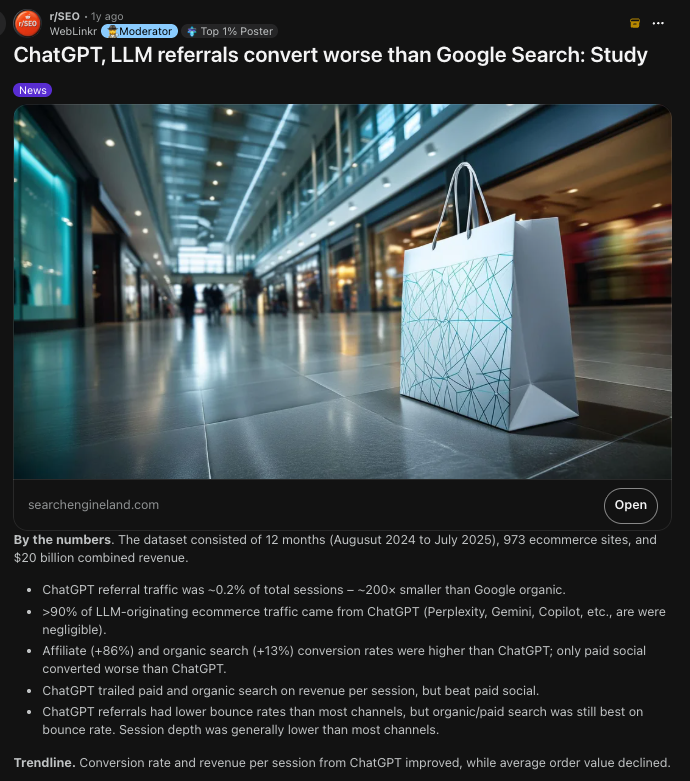
Your results will depend on what you sell. One r/SEO thread shared a study where ChatGPT traffic was 0.2% of visits and converted worse than Google for an online store. A law firm SEO replied that ChatGPT visitors convert better for his clients. They only make up 1 to 3% of his traffic, though. Both are true. If people research carefully before buying from you, expect the upside first.
Retail sites, finance and legal are pulling ahead
Adobe measured AI-driven traffic to US retail sites up 693% during the 2025 holidays. Travel rose 539%. Financial services rose 266%. User behavior is shifting fastest wherever people do homework before spending. I see the same pattern in ecommerce SEO work and in SEO for law firms. In legal, a single AI-referred inquiry can be worth thousands of dollars.
What Google AI Overviews do to your clicks
On Google, the story is about clicks you used to get. Ahrefs studied 300,000 keywords and found the number one result loses 58% of its clicks when an AI Overview sits above it. Pew Research found people clicked a regular result on 8% of searches with an AI summary versus 15% without one. SparkToro’s data shows 68% of US Google searches now end with no click at all.
There is a way through. Seer Interactive tracked 5.47 million searches and found pages cited inside the AI Overview earned about 20,743 clicks per million views. Pages sitting below the overview with no citation earned about 9,445. Getting cited pays 120% more than ranking underneath. I break down the how-to in my guide on how to rank in AI Overviews. My look at the AI Mode SEO impact covers the newer feature. One calming number: AI Mode was used on only 0.34% of Google searches in early 2026. The panic is running ahead of the data.
Not sure if AI search is sending you customers yet?
What LLMs Prefer to Cite: Brand Mentions, Relevant Entities, and Google’s Knowledge Graph
This is where LLM SEO parts ways with the SEO you may have paid for before. The things that predict whether an AI names your brand are different from the things most agencies have been building.
Brand mentions beat link building (and YouTube beats both)
For years, the big authority signal was backlinks: other websites linking to yours. Ahrefs studied 75,000 brands to see what actually predicts showing up in AI Overviews. Plain mentions of your brand name on other websites, with or without a link, were three times more predictive than backlinks. Brands in the top quarter for mentions appeared in AI Overviews about 169 times each. The next quarter down appeared 14 times.
A follow-up study in December 2025 found an even stronger signal. Mentions on YouTube predicted AI visibility better than anything else measured, across ChatGPT and Google’s AI features alike. Your website’s overall authority score barely registered by comparison.
Backlinks still matter for Google rankings, and Google rankings still feed Google’s AI. The new lesson is that getting talked about deserves equal budget. Digital PR, guest articles in industry publications, and podcast interviews all create the mentions AI learns from. Most businesses have not caught on. NP Digital surveyed 200 people doing this work and found only 6% invest in digital PR. Yet getting content placed on third-party sites showed a median 239% jump in AI citations. The outreach marketing playbook has barely changed. Its payoff has.
Relevant entities and Google’s Knowledge Graph
“Entity” is a fancy word for a thing the AI recognizes as real and distinct. A company, a person, a product, or a place. Google’s Knowledge Graph is the biggest public list of them. Your business name and what you do should read the same way everywhere. That means your website, your Google Business Profile, and your directory listings. When they match, the AI can connect the dots. When they conflict, it gets unsure and picks a competitor it understands better.
Start with a simple check. Does your About page describe you the same way your Google Business Profile does? Do your top directory listings agree? Then look at which companies the AI currently associates with your topic. Clearscope’s Bernard Huang summed it up: topics are the new keywords. The AI asks whether you belong to a topic. Phrase counts do not come into it. Publishing thought leadership content under a real name with a consistent bio gives the AI a person to attach your expertise to.
The formats LLMs cite most
Ahrefs pulled together 14 studies covering over a billion data points. “Best X” list posts made up 43.8% of all pages cited by AI chatbots. The surprise was length. 53% of cited pages were under 1,000 words. Depth still wins at the far end, though. Fractl found pages over 20,000 words cited at five times the normal rate. So LLMs prefer content that is either a tight, complete answer or the definitive reference on a topic. The 2,000-word blog post in the middle tends to get skipped.
Ghost citations: when the AI uses you but doesn’t name you
In June 2026, Semrush coined a term that every business owner should know. A ghost citation is when an AI answer links to your page but never says your brand name. Their study found 62% of AI citations work this way. ChatGPT links to a source 87% of the time but names the brand only 20.7% of the time. Gemini does the reverse.
The fix is simple, and almost nobody does it. Put your brand name inside the sentence that carries the fact. “In our review of 40 client sites, [Your Brand] found…” hands the AI a name to repeat. A byline at the top is easy for it to drop. Comparison-style questions produced 2.4 times more brand mentions than general ones, so comparison content is where brand recognition grows fastest.
What Brands Did and What Moved
Every top-ranking guide on this topic has zero or one case study. Here are seven, with real numbers and the specific things each company did. Two come from vendors selling AI visibility software, and I flag them.
HubSpot: 1,850% more qualified leads from AI
HubSpot published its own results in 2026. Qualified leads from AI sources jumped 1,850% and closed at three times the rate of other channels. Citations rose 433%. The tactics were unglamorous. Pages built for specific industries got cited 92% of the time. Comparison articles lifted citations 642%. An FAQ glossary helped. HubSpot also got serious about Reddit, and its Reddit citations went from 178 in May 2025 to 146,000 by December.
Vercel: ChatGPT as a signup channel
Vercel, a software company, watched ChatGPT referrals grow from 1% to about 10% of new signups in six months. Two lessons stood out. Most AI crawlers cannot read pages that depend on JavaScript to load, so they fixed that first. And they stopped writing about popular topics everyone covers and became the best source on narrow topics nobody had covered well.
Go Fish Digital: an agency tests its own advice
Go Fish Digital ran a 90-day program on its own website. AI referral visitors rose by 43%, and AI conversions rose by 83%. Visitors from AI converted at 25 times the rate of Google visitors. Their method was simple. Figure out the questions customers ask AI. Then build five to eight fact-heavy pages that answer every smaller question inside them.
Broworks: a small agency in 90 days
Broworks is a small web design agency. Within 90 days, 10% of its organic traffic came from AI tools and 27% of those visits turned into qualified sales conversations. The changes were modest: proper schema on the site plus a short summary box at the top of each blog post. Of everything on this list, this is the most repeatable for a small business.
Brand | Result | What moved it |
|---|---|---|
Semrush (own site) | Share of AI answers mentioning them went from 13% to 32% in one month | Tracked 39 target questions and filled the gaps (Semrush’s write-up) |
Ramp (vendor case) | AI visibility for accounts payable from 3.2% to 22.2% in about a month | “Top 6” style pages built to be cited (Profound case study) |
Anonymous B2B software company (agency case) | Free trials from AI grew from 575 to over 3,500 a month in seven weeks | 66 answer-first articles plus Reddit activity (Discovered Labs case) |
Notice what every case has in common. Each one wrote content that answers specific questions completely, then earned mentions where the AI already looks. Nobody credits a technical trick. That is the same recipe behind the content marketing results I report to clients, with a new place to measure them.
Optional insert: one paragraph with your own client data. Even “AI referrals went from 0 to 2% of visits in six months” beats every competitor on this SERP.
How to Optimize Content for AI Responses
The old version of this article had an eight-point checklist. Checklists are easy to skim and easy to forget. Here is the method I actually use, with the data behind each step.
Write answers that stand on their own
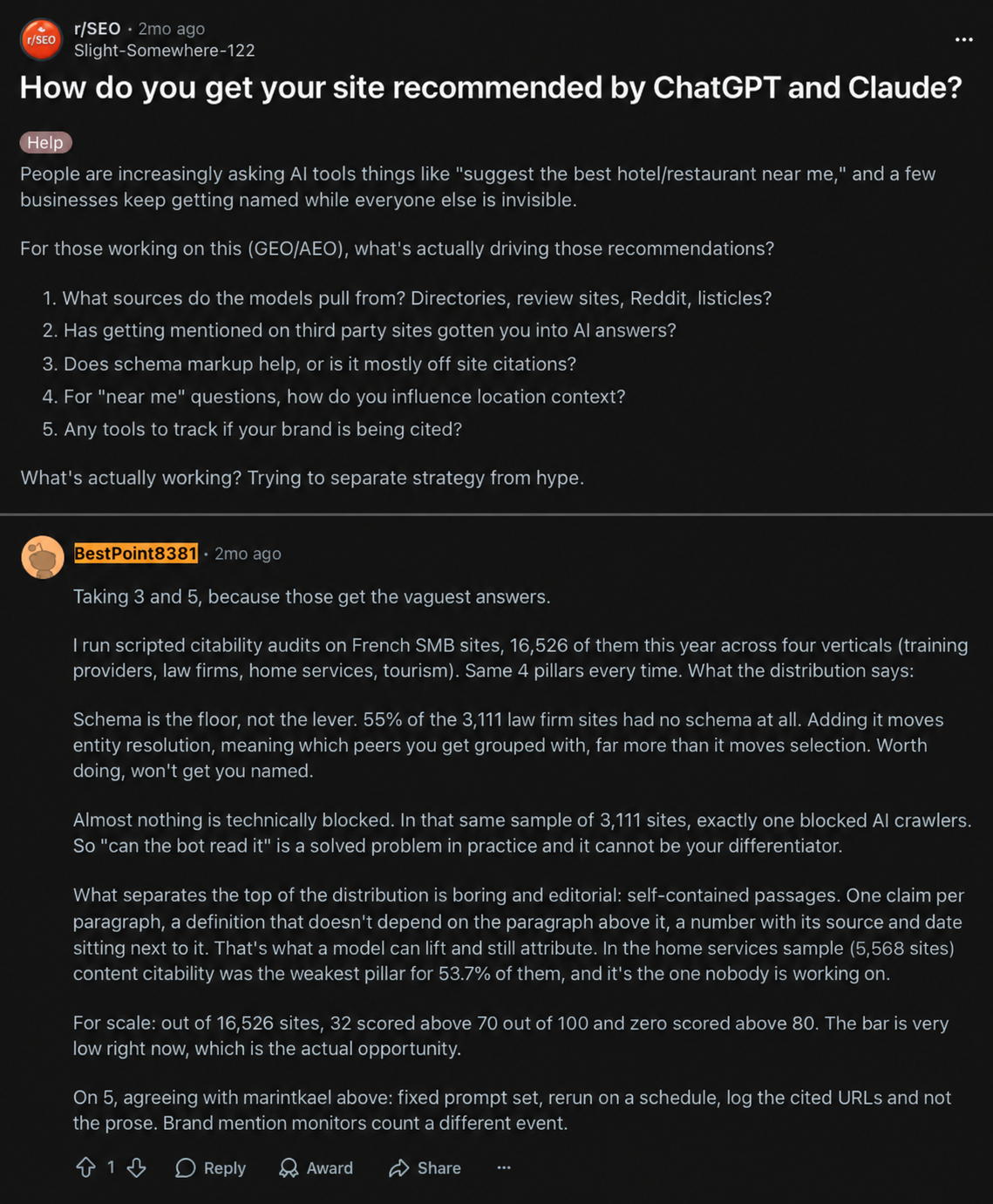
AI systems lift individual passages from your page, one paragraph at a time. If a paragraph only makes sense after reading the three above it, the AI skips it. So open every section with a complete answer to the question in the heading. Stick to one idea per paragraph. Explain terms where you use them. A commenter on r/SEO said it well: “What separates the top of the distribution is boring and editorial: self-contained passages. One claim per paragraph, a definition that doesn’t depend on the paragraph above it.”
Write your headings the way people actually ask. “How much does local SEO cost for a dentist” beats “Pricing.” You are matching user intent and natural language queries. Exact keyword matches happen on their own.
Lead with numbers, quotes, and sources
The most cited research on this comes from Princeton. Across 10,000 test questions, adding statistics and cited sources raised a page’s visibility in AI answers by up to 40%. Keyword stuffing did worse than doing nothing. A specific number with a source gives the AI something concrete to repeat. A vague claim gives it nothing.
Use clean HTML and schema markup, with realistic expectations
Clear headings and clean semantic HTML make your pages easier for machines to read. Do that. Schema markup (the structured data code that labels what a page is about) needs a more careful answer. Ahrefs found AI-cited pages were three times more likely to have schema. Then it ran a real test and added schema to 1,885 pages. The result was no meaningful change in citations. Both can be true. Well-run sites tend to have schema and get cited because they are well run. Add Organization and Article and FAQ schema for clarity and for Google’s rich results. Just do not expect it to move AI visibility by itself.
Build topic clusters with internal linking
The AI asks whether you belong to a topic. One great article cannot prove that. A main guide with eight supporting articles and deliberate internal linking between them can. The links also help the AI find your supporting pages when it lands on the main one. Use link text that names the subtopic. Good on-page SEO basics still apply to every page in the group.
Keep your pages fresh
Ahrefs looked at 17 million pages cited across seven AI platforms. AI tools cited content that was on average about a year newer than what Google’s regular results show. ChatGPT leaned newest of all. Google’s AI Overviews showed no preference either way. If ChatGPT matters to your business, a refresh schedule matters. My rule for when to update blog content is simple. Any page with a statistic older than 18 months gets reviewed.
Let the AI crawlers in
BrightEdge found 77% of websites block AI crawlers from learning from their content. Only 19% have set any rule for ChatGPT’s crawler at all. Many did it by accident, due to a plugin or a default setting. Blocking the training crawler keeps you out of what the AI learns. Blocking the search crawler keeps you out of live answers. Decide on purpose. Then check whether your pages load their text without JavaScript. Most AI crawlers cannot run it. These are the technical SEO fixes that decide whether anything else on this list can work.
Get indexed on Bing
ChatGPT’s live searches run on Bing. If Bing has never indexed your page, ChatGPT cannot find it. Set up Bing Webmaster Tools and turn on IndexNow so new pages reach Bing within minutes. Only two of the top ten guides on this topic mention it. It takes one afternoon.
LLM Optimization Hacks That Don’t Work
The title of this guide promises hacks. The most useful thing I can do is tell you which ones are dead so you stop paying for them.
llms.txt
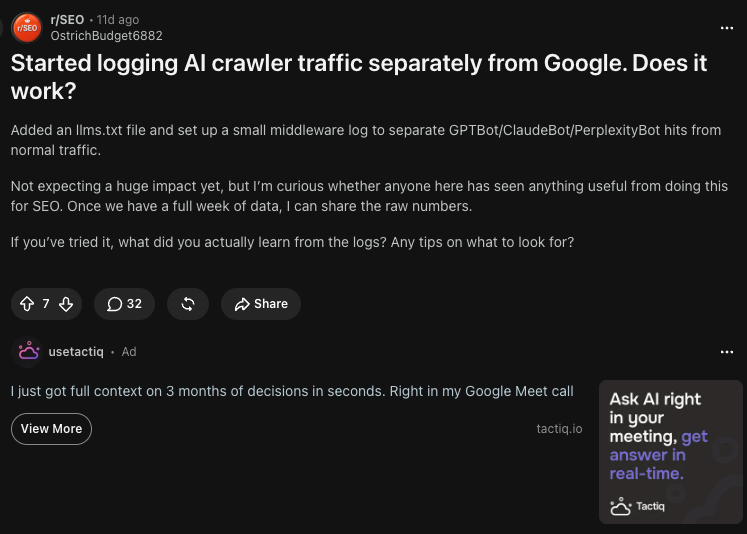
You may have been told to add a file called llms.txt to your website. It is meant to be a summary written for AI. Plenty of guides recommend it. Ahrefs checked 137,210 websites in June 2026. Of the 28% that had the file, 97% got zero requests for it all month. Among the 3% that were fetched, 96% of requests came from bots, mostly SEO tools checking whether the file existed.
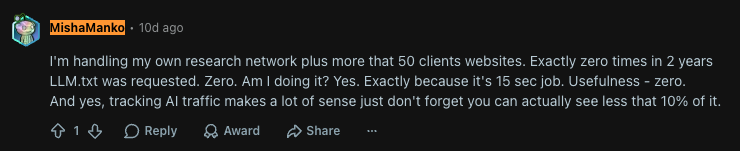
Google’s John Mueller said it a year earlier: “no AI system currently uses llms.txt.” One r/SEO member who tracks crawler visits reported the file was requested “exactly zero times in 2 years.” Add one if you want. Expect nothing from it.
Google’s own list of things you can skip
Google published an AI optimization guide with a mythbusting section. You do not need to chop content into AI-sized chunks. You do not need to rewrite pages “for AI.” Structured data is optional for AI features. The old version of this article recommended “token-friendly paragraphs.” Google says the AI handles that on its own. Write for the person reading.
Gaming the AI and content farms
Researchers have shown you can trick AI recommendations by hiding special text strings in a page. One study bumped a product’s rank by about 40% this way. Treat these as attacks. Platforms patch them. A brand caught doing it loses the trust that everything in this guide depends on. Mass-produced list posts have the same problem.
The NP Digital survey found 68% of practitioners lean on self-published listicles. That worked until January 2026. Google’s crackdown then cut listicle visibility by 29 to 49% for many sites. Unedited AI content follows the same path. It repeats the average of what already exists. The AI has no reason to cite the average. My guides on how not to do SEO and whether Google penalizes AI content go deeper on both.
Beyond Your Website: Reddit, YouTube, LinkedIn, and Digital PR for Brand Presence
AI platform | Sites it cites most (late 2025) |
|---|---|
ChatGPT | Wikipedia, Reddit, Medium, Forbes, LinkedIn |
Google AI Mode | LinkedIn (about 15% of citations), YouTube, Reddit |
Perplexity | Reddit, LinkedIn, NIH |
Source: Semrush most-cited domains study, November 2025.
One warning before you rush to Reddit. That same study caught Reddit’s share of ChatGPT citations dropping from about 60% to about 10% in a single month. Profound’s look at 680 million citations had Reddit at 6.6% of Perplexity citations and Wikipedia at 7.8% of ChatGPT’s. These numbers move around. A brand presence built on one platform is one software update away from zero.
Reddit, done right.
HubSpot’s Reddit citations went from 178 to 146,000 in seven months. They answered real questions under real names and wrote content people wanted to reference. Dropping links played no part. Apollo.io built its own community on Reddit. It reached a 63% brand mention rate when people asked AI about its category. It is the same approach that has always worked for user-generated content: show up and be useful.
YouTube, the strongest signal.
You do not need a studio. One clear explainer video on your core topic gives the AI a source it already trusts. Add a full transcript. The usual video SEO basics apply: a descriptive title, a full description, and chapters.
Earned media over self-published.
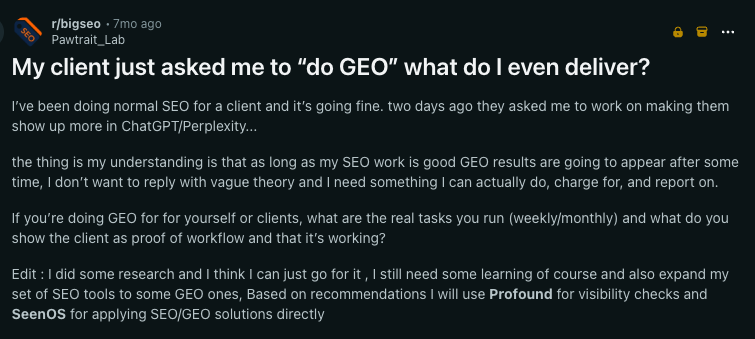
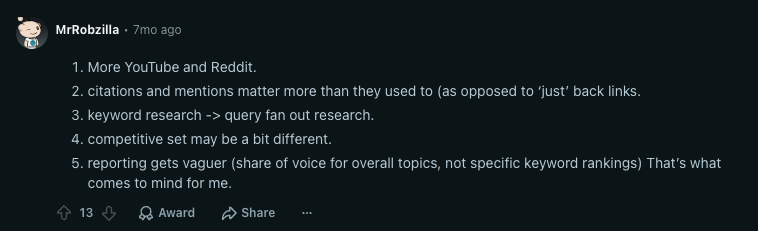
Fractl’s data puts news sites at 14% of all AI citations. That rises to 18% when someone is about to make a decision. Press releases sent through wire services saw five times more citations in the second half of 2025. Guest articles, expert quotes and podcast appearances all count. An SEO on r/bigseo summed up a client plan in one comment: “More YouTube and Reddit. Citations and mentions matter more than they used to. Keyword research turns into query fan-out research.” That is this whole section in three sentences.
Need someone to handle the content and the outreach? Let's talk.
How to Measure LLM Visibility and AI Search Referrals in Google Analytics
Semrush’s 2026 AI Visibility Index found 45% of marketing leaders cannot measure AI mentions of their brand. The same report compared companies that run SEO and AI visibility as one program against those that split them. The first group saw more leads 81% of the time. The second managed 36%. You cannot manage what you cannot see, and right now most businesses cannot see it.
- Set up an AI traffic channel in Google Analytics. Create a custom channel group with a session source rule that catches the major AI platforms. This pattern covers most of them:
chatgpt\.com|openai\.com|perplexity\.ai|gemini\.google\.com|claude\.ai|copilot\.microsoft\.com
Then compare how those visitors convert against your Google visitors. This one report turns “AI is coming” into a line on your dashboard.
- Check Search Console’s generative AI report. Google’s AI guide points to a generative AI performance report in Search Console. It shows AI Overviews and AI Mode separately from regular results. If you have never opened it, that is where your Google-side AI data has been sitting.
- Choose the questions to track. Tracking questions is the AI version of tracking keyword rankings. Most businesses only track questions with their brand name in them. Start with the searches in your Search Console and rewrite them as full questions. One agency owner on r/bigseo described the process. Paste your Search Console keyword list into ChatGPT. Ask it to turn each one into a question a real person would ask. Then read your sales emails and Reddit for the real wording. My keyword research tips post covers how to build that starting list.
- Pick a tool and check it monthly. Ahrefs Brand Radar, Semrush AI Toolkit, Profound and Peec AI all track how often AI mentions your brand. Semrush found 40 to 60% of cited sources change from one month to the next. Only 36 brands stayed in the top 100 across all four major AI platforms every month in early 2026. That churn is why AI visibility belongs in ongoing SEO analytics reporting. A one-time audit goes stale within a quarter.
- Be honest about credit. Branded searches and direct visits are your stand-ins for AI influence you cannot see. Want proof that AI work caused a lift? Use the test an r/SEO commenter suggested. If you rewrote 12 pages for AI and left 30 alone, check whether the 12 moved and the 30 did not.
Optimizing for Each AI Platform: ChatGPT, Google Gemini, Perplexity, and Claude
Many AI models share the same basics and differ in the details. Here is how the four that matter most behave, based on Similarweb’s AI search statistics for June 2025 through May 2026.
Platform | Share of AI traffic | Where it searches | Sources per answer | What to focus on |
|---|---|---|---|---|
ChatGPT | 53% (down from 76%) | Bing | About 15 | Get indexed on Bing, publish list and comparison posts, keep pages fresh, be present on Wikipedia and Reddit |
Google Gemini / AI Mode | 27 to 28% (up from under 9%) | About 3 | Google rankings, consistent business details, YouTube and LinkedIn presence | |
Perplexity | About 1.3% of visits | Its own crawl plus partners | Varies | Top 10 Google rankings (28.6% overlap), Reddit, trusted sources |
Claude | About 9% (up from 2%) | Its own search | Varies | Clear factual content, help documentation, consistent business details |
Two shifts stand out. Gemini tripled its share in a year. Your Google rankings now matter more for AI visibility than they did in 2025. Claude grew from a rounding error to nearly a tenth of AI traffic. Almost nobody is optimizing for it. ChatGPT is changing shape too. It now cites the web in 6.8% of answers, up from 1.6% a year earlier. About 26% of its responses carry an ad.
Where LLM SEO Is Heading
Predictions about AI-driven search have a poor track record. Let me grade a few before adding my own.
Gartner predicted in 2024 that traditional search volume would drop 25% by 2026. It did not happen. SparkToro’s early 2026 data puts AI tools at 1.65% of US desktop visits against Google’s 94.3% share of search. People are still Googling as much as ever. They are just clicking less. Ahrefs’ Q1 2026 benchmark found Google still sends 190 times more traffic than ChatGPT.
Semrush projects AI search visitors will overtake traditional search visitors for SEO and marketing topics by early 2028. Earlier versions of this article repeated a 2027 date that appears nowhere on Semrush’s page. Treat 2028 as one scenario for one industry.
The prediction I take most seriously comes from BrightEdge. AI agents are software that browse websites on a person’s behalf. In early 2026, they made 88% as many requests as human searchers. BrightEdge expects them to pass humans by the end of the year. An agent visiting your site to compare prices for a customer is a new kind of visitor. It never sees your hero image. It reads your facts and leaves. Pages built so a machine can pull a clear answer will serve it well.
Make Your SEO for LLM Strategy Work Alongside Traditional SEO
Nothing in this guide replaces good SEO. Search algorithms, Google rankings, and useful content still do most of the work. LLM SEO adds a new place for customers to find you and a new set of numbers to watch. The businesses winning AI visibility in 2026 do three things. They publish pages an AI can lift a clean answer from. They earn mentions in the places AI already reads. They measure the result somewhere other than a rankings report.
Start with the pages you already have. Most businesses can show up in AI answers with what they already own. It takes your best twenty pages rebuilt so an AI can pull a complete answer from each one. Add a few mentions in the places the AI already reads. That is what my content optimization work focuses on.
Want a second pair of eyes on which pages those are? Send me your URL, and I will tell you where I would start.

Ready to get your brand into AI answers?
FAQs About SEO for LLMs
Is SEO dead now with AI?
No. Google still sends about 190 times more traffic than ChatGPT, and Google’s AI features mostly cite pages that already rank well. What changed is that 68% of Google searches now end without a click and more buying research happens inside AI answers. SEO is still the foundation. LLM SEO is the layer that gets you cited on top of it.
What is AI SEO called now?
You will see four names for the same work: LLM SEO (or LLMO), generative engine optimization (GEO), answer engine optimization (AEO), and AI SEO. GEO is the most searched term and the one researchers use. They all mean getting your brand named or cited in AI answers.
What's the LLM equivalent of SEO?
Large language model optimization, usually shortened to LLMO or LLM SEO. You shape your content and your brand’s presence across the web, so AI tools pick you as a source. Getting one page to rank for one keyword is only a small part of it.
Is GEO replacing SEO?
No. Google’s own guidance says the same basics apply to AI search. Every case study above started with a website that was already well built. GEO extends SEO onto new platforms that cite differently and get measured differently. Companies that run both as a single program get better results than those that split them.
Which generative engine optimization tool is the best?
It depends on what you need to see. Ahrefs Brand Radar and Semrush AI Toolkit make sense if you already pay for those platforms. Profound and Peec AI go deeper on tracking citations across many AI models. Start with whatever your current SEO tool already offers before buying something new.
How do you measure LLM search visibility?
Use three views together. Build an AI traffic channel in Google Analytics to see visits and sales from ChatGPT and its peers. Open Search Console’s generative AI report for Google’s AI Overviews and AI Mode. Then use a tracking tool to see how often AI answers mention your brand for the questions your customers ask.
Does AI search favor large brands?
Less than you would think. Semrush found only 15.2% of product categories have a clear brand winner in ChatGPT. Ahrefs found the strongest predictor of AI visibility is how often your brand is mentioned across the web. Domain authority trails far behind. A small brand with consistent mentions and specific answers can beat a bigger competitor that has neither.