
Quick Answer: If you only have time for one AI tool, pick ChatGPT for daily productivity, Claude for long-form writing that sounds human, and Perplexity when you need stats with sources. Gemini earns its keep inside the Google ecosystem, and Grok is best for real-time X/Twitter chatter. Most content and SEO workflows benefit from combining two or three of these AI models, not picking one winner.
Everyone has an opinion on which AI is the best AI assistant. Most of those opinions come from someone who picked one tool and stopped testing the rest. Debates over the best AI models tend to happen between people who’ve only tried one or two.
I’ve been working with multiple AI models daily for content marketing and SEO. ChatGPT, Claude, and Perplexity are part of my regular stack. Gemini and Grok I don’t personally lean on, so I’ll pull from Reddit threads, community reviews, and how other users describe their experiences with these AI chatbots.
This isn’t a benchmark dump. It’s what happens when you sit down to write a client brief, dig into keyword research, or draft a long-form blog post. If you’re looking for real advantage in your workflow, here’s what you need to know.
Key Takeaways
- ChatGPT is the strongest generalist. Great for seed keyword ideas, brainstorming, and quick research summaries.
- Claude wins on long-form writing. It’s the closest to a human tone and holds context better across edits.
- Perplexity is the go-to for finding statistics and sourced claims for blog content.
- Gemini shines inside Google Workspace and for multimodal tasks like image generation.
- Grok carves out a niche for real-time X/Twitter data and social sentiment, but isn’t a fit for serious content work.
ChatGPT
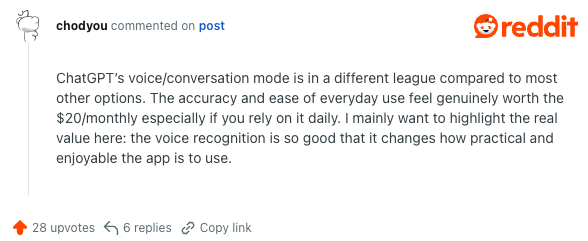
ChatGPT is the AI assistant most people have used at least once. It’s the default answer when someone asks about AI tools, and there’s a reason for that.
What ChatGPT Gets Right
ChatGPT has the broadest ecosystem of any large language model on the market. It handles brainstorming, structured outlines, and quick summaries with less prompting than the others. When I need to reformat data into a table or turn a messy set of notes into a clean list, ChatGPT does it in one shot.
Voice mode and the code interpreter matter in some workflows, especially for developers who use them for coding assistance during software development. Custom GPTs give power users a way to build reusable prompt setups for specific tasks, including basic agentic tasks like scheduled research or repeatable data pulls. For free users, the base tier is enough to get real productivity gains without paying a cent.
Where ChatGPT Falls Short
The biggest issue with ChatGPT is confident-but-wrong answers, especially on complex topics where nuance matters. It rarely says “I don’t know.” It will give you a plausible-sounding response that turns out to be off, and if you’re not fact-checking, you’ll miss it.
Writing at scale is where the cracks show. ChatGPT falls into repetitive tone patterns. If you’ve read enough AI-generated content, you can spot it in three sentences. It also drifts from the brand voice without heavy prompting, which is a real problem for content creation.
How I Use ChatGPT for SEO and Content Work
ChatGPT is where I start most projects. I use it for seed keyword research, feeding those ideas into SEMrush for the actual data. It helps me generate angle ideas for briefs and gives me a starting point when I’m stuck on a topic.
For quick summaries or reformatting data, it’s my first pick. For the final published draft, I move to Claude. If you’re serious about keyword research for your SEO strategy, ChatGPT is a solid brainstorming partner, but it shouldn’t be the last word on your keyword list.
Claude
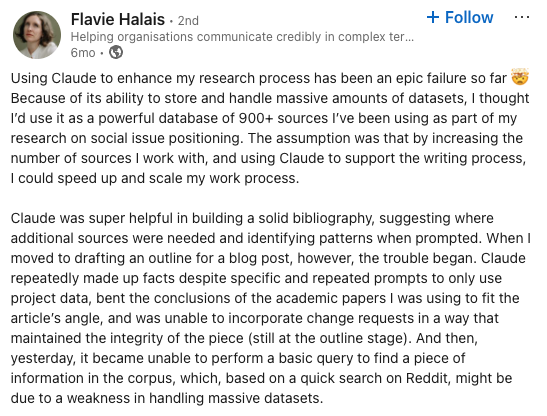
Claude is Anthropic’s model, and it’s the one I default to for anything that needs to sound like a person wrote it. Claude Sonnet and Claude Pro (their paid tier) get most of the attention, but the writing quality is what keeps me coming back.
What Claude Gets Right
Claude excels at long-form writing. It holds context across long documents without losing coherence, which matters when you’re drafting a 2,000-word blog post or a service page with multiple sections.
Claude focuses more on being honest about what it doesn’t know. When it’s not sure about something, it will say so rather than fabricate. Anthropic’s training approach leans heavily on safety and reduced hallucination, and it shows in the output. That’s a real advantage when accuracy matters. For long-form reasoning, structured output, and nuanced rewrites, most content marketers choose Claude as the more reliable choice.
Where Claude Falls Short
Claude has fewer integrations than ChatGPT or Gemini. There’s no equivalent to custom GPTs, and the plugin ecosystem is smaller. Enterprise controls have caught up on the paid tier, but if you want your AI to connect to a dozen other tools out of the box, Claude isn’t there yet.
It’s also not built for real-time web search out of the box. You can enable it, but it’s not the default experience. And Claude can be conservative on creative asks. If you want it to push the envelope, you have to nudge it harder than ChatGPT.
How I Use Claude for SEO and Content Work
Claude is where the actual writing happens. Content outlines, briefs, full drafts, rewrites of AI-generated content that clients send me. When I need something that reads as if a human wrote it, Claude gets the job.
I also use it for editing. If I have a draft from another tool or writer, I use Claude to clean up tone, tighten sentences, and make sure the piece flows. This is the same approach I use when deliveringHuman + AI content writing services, where the AI handles the first draft and a human refines everything after.
Gemini
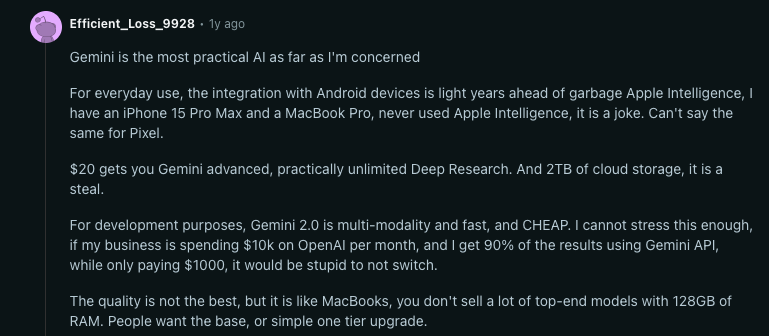
I don’t use Gemini much personally. My workflow lives outside Google Docs most of the time, so the biggest selling point for Gemini doesn’t apply to me. But Gemini has a strong user base, and the feedback from those users is worth listening to.
What Gemini Gets Right
Gemini’s biggest strength is the Google ecosystem tie-in. If you live in Gmail, Google Docs, and Sheets, Gemini is already inside your workflow. It can summarize long email threads, draft replies, view image attachments, and generate first drafts of documents without leaving the app.
The context window is huge. Gemini can process up to a million tokens, which means it can handle long documents, entire books, or full codebases in one thread. Content creators on Capterra call out its image generation as a standout feature for social media posts and product mockups.
Where Gemini Falls Short
Users on Reddit describe Gemini’s writing tone as “robotic” or “corporate” compared to ChatGPT. It gets the facts across but lacks warmth. For content marketing where voice matters, that’s a real gap.
Some capabilities are gated behind the paid Advanced tier, which unlocks higher limits and full file upload access. One writer noted the free tier only lets you upload images, not other file types. Small detail, but it’s the kind of thing that pushes people to test the paid version and then decide whether it’s worth it.
How Other Users Rely on Gemini
Reddit users in r/GoogleGemini praise Gemini for real-time research and Google Workspace-native tasks. Tom’s Guide reviewers use it daily for brainstorming and summarizing long email threads. Capterra reviewers highlight the image generator, especially when they need consistent characters across a set of images.
For anyone deep in the Google ecosystem, Gemini is a natural fit. For content marketers who care more about tone than integration, it’s usually a secondary tool, not the main one.
Perplexity
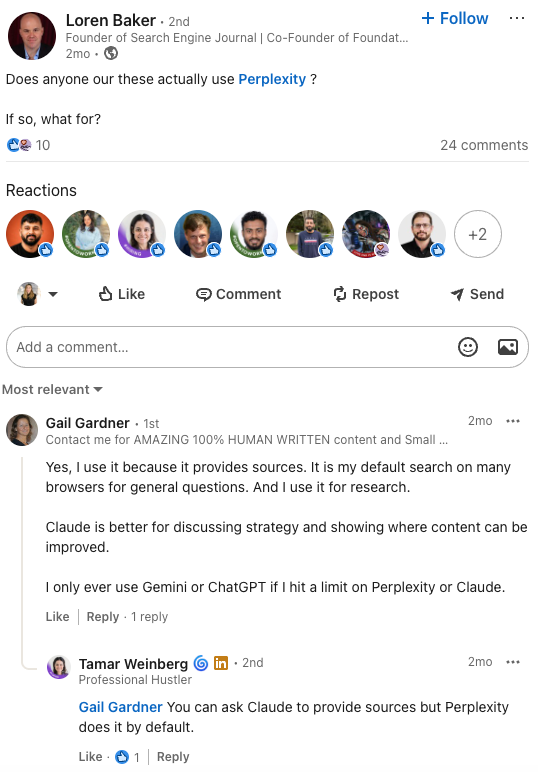
Perplexity isn’t trying to be a general-purpose AI chatbot. It’s built for research, and that focus is what makes it useful.
What Perplexity Gets Right
Perplexity retrieves live web search results with visible citations. It’s the AI tool I trust most when I need to find a statistic and know where it came from. Independent benchmarks show Perplexity has the lowest citation error rate of the major AI tools, and while it’s not perfect, it’s the closest thing to a research assistant that shows its work.
It’s also great for competitor content research and light data analysis. When I’m writing about a topic and want to see what’s already out there, Perplexity pulls fresh search results and cites its sources. That saves me from opening ten browser tabs.
Where Perplexity Falls Short
Perplexity isn’t for creative writing or long-form content. The answers are concise and can strip out context you actually need. If you ask it to write a 1,500-word blog post, you’ll get something readable but lifeless.
The other issue is that Perplexity’s citations aren’t always accurate. The URLs are real, but the claim attributed to them can be off. You still have to click through and verify anything you’re going to publish under your name.
How I Use Perplexity for SEO and Content Work
Perplexity is where I go for stats. When I’m drafting a blog post and I need a data point, I ask Perplexity, click through to the source, and confirm the number before dropping it into the draft.
I use the free tier. Most of my research needs don’t justify a paid subscription, and the free version handles enough queries per day for a single-user workflow. Even without paying, Perplexity remains my top pick for sourced research and quick decision-making on which stats to include in a draft. This is the same approach I bring to SEO content writing services, where every stat gets checked against the original source before publication.
Grok
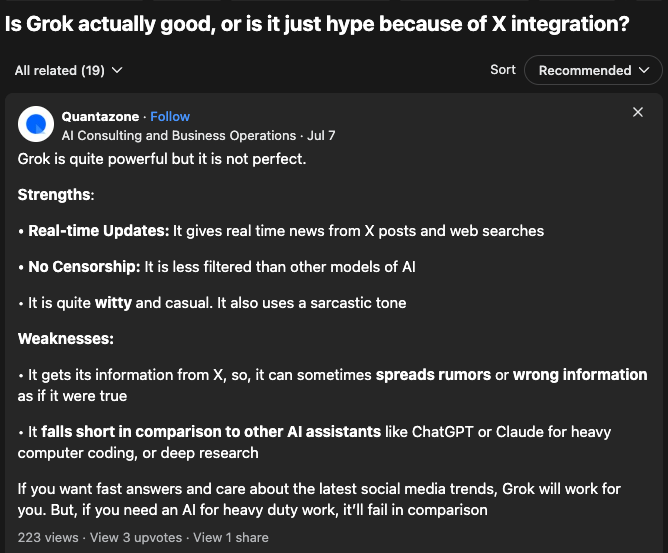
Grok is xAI’s AI assistant, built into X (formerly Twitter). I’ve never used it for SEO or content work, so this section leans entirely on what other users report.
What Grok Gets Right
Grok’s real advantage is direct access to real-time data from X. It knows what happened on the platform five minutes ago, which other AI models can’t match without extra tooling. For breaking news, viral trending topics, and social sentiment, it’s built for the job.
Response speed is fast. Users describe it as more conversational and less filtered than ChatGPT, with what Elon Musk calls a “rebellious streak.” It also has an image generator built in (Aurora), and users can access it directly through X without a separate app.
Where Grok Falls Short
Grok has the weakest citation accuracy of the five tools compared here. Independent tests have flagged citation error rates that are significantly higher than those of Perplexity or even ChatGPT Search. If you’re using AI for research where sources matter, Grok isn’t the right pick.
Its ecosystem is smaller. Fewer integrations, less enterprise adoption, and a narrower use case. For content creation that needs polish or accuracy, other tools do the job better.
How Other Users Rely on Grok
Journalists and traders use Grok for breaking news summaries pulled directly from X. Creators use it for trend analysis and quick content ideas based on what’s currently viral. Users on developer communities describe it as useful for real-time synthesis when they need to understand what people are actually saying about a topic right now.
Some Reddit users describe it as the “fun” option because of its less filtered tone. That’s not what I need for client work, which is why I’ve never touched it. For someone tracking social media platforms and wanting real-time pulse checks, Grok fills a gap the others don’t.
Head to Head: Where Each One Actually Wins
Here’s how the five AI tools stack up head-to-head across the tasks I care about most for SEO and content work:
| Task | Best Pick | Runner-Up |
| Long-form writing | Claude | ChatGPT |
| Seed keyword research + brainstorming | ChatGPT | Claude |
| Stats and sourced research | Perplexity | Gemini |
| Google Workspace tasks | Gemini | ChatGPT |
| Image generation | ChatGPT | Gemini |
| Real-time social/X trends | Grok | Perplexity |
| Coding and code generation | ChatGPT | Claude |
| Citation accuracy | Perplexity | Claude |
| Handling long documents | Gemini | Claude |
The winner for each row depends on what you’re doing that day. Most content marketers end up using two or three of these, not one. That’s the honest read on the ChatGPT vs Gemini vs Claude vs Grok debate. Nobody hands you a single tool that covers every job.
Other AI models like Microsoft Copilot and Meta AI are worth watching too, but for content and SEO work, the five compared here remain the most common picks.
No single tool is a game changer by itself. The real gains come from knowing which one to use when. The AI space moves too fast for any one model to lead across every task, and choosing based on a single benchmark misses the bigger picture.
How I Combine Them in a Real SEO Content Workflow
This is where most comparison articles stop. They tell you which AI tool is best in isolation and skip the part where you actually have to get work done. Here’s how the five tools fit into a real content workflow:
- ChatGPT — Seed keyword research to help me use SEMrush. I ask ChatGPT to brainstorm ten to fifteen related search terms, then feed those into SEMrush to pull real search volume, competition, and related keyword data. ChatGPT is also where I sketch out angle ideas for briefs before committing to a direction.
- Claude — Outline building and full drafts. Once I have keywords and an angle, Claude takes over. It handles the outlining, writing, and editing. If a client sends me AI-generated content that needs a rewrite, I use Claude to do that too. This is baked into how I approach content brief creation so writers get structure without losing creative room.
- ChatGPT + Gemini — Image generation. ChatGPT is my first stop for visuals. If it doesn’t hit the mark, I move to Gemini as a backup. Gemini’s image generator is stronger for realistic product shots, while ChatGPT handles stylized concepts better.
- Perplexity — Finding stats with sources. Every time I need a data point to back up a claim, Perplexity is faster than opening ten tabs. I click through to the source, verify the number, and drop it in.
- Grok — Never used it. If you’re tracking social sentiment or need real-time X data, it might fit your workflow. It’s not part of mine.
This combination is what makes the difference between AI-generated content that sounds like everyone else’s and something a reader actually finishes. If you’re looking for content marketing services that use AI thoughtfully rather than as a shortcut, this is the framework I bring to every client project.
Skip the Guesswork and Get Real SEO Results
Every one of these AI tools has a real strength and a real weakness. Picking the “best AI” is the wrong question. The better one is which tool fits the job you’re doing right now.
Most business owners don’t have time to test five AI models across every task. They need someone who already knows what each one does well, when to use it, and when to leave it alone.
That’s what I do every day for clients who want content that ranks and reads as if a human wrote it. If you’re ready to stop guessing and start building an SEO strategy that actually moves the needle, let’s talk about what your business needs.
Let’s Talk AI Visibility
FAQs About AI Platforms
Which is better: ChatGPT, Claude, Gemini, or Perplexity?
Depends on the task. Claude is better for long-form writing. ChatGPT is better for daily productivity and brainstorming. Perplexity wins for research with sources. Gemini is the strongest pick if you work inside Google Docs and Google Workspace all day. There’s no single “best” answer across every use case.
Which is better: ChatGPT, Grok, or Claude?
For content and SEO work, ChatGPT and Claude beat Grok. ChatGPT is the more versatile all-arounder. Claude is better for long-form writing that needs a human voice. In the Grok vs ChatGPT or Grok vs Claude debate, Grok is best only if real-time X data is central to what you’re doing, which for most content marketers, it isn’t.
Which is best: Claude vs ChatGPT vs Gemini?
Claude excels at writing quality and long-form reasoning. ChatGPT wins on ecosystem, integrations, and general versatility. Gemini is the best pick if your work lives inside Google’s tools. Pick based on where you spend most of your time and what output matters most to your workflow.
What is currently the best AI right now?
There isn’t one. Different models lead in different categories. Claude leads on writing quality. ChatGPT leads on ecosystem and integrations. Perplexity leads on citation accuracy. Gemini leads on multimodal capabilities and Google ecosystem depth. Grok leads on real-time X access. The best AI assistant is the one that fits the specific task at hand.
Related GEO/SEO Posts

ROI in Digital Marketing: Ultimate Guide
Short for return on investment, ROI is a mathematical formula you can use to evaluate your investments and determine how they perform—whether or not your efforts are actually helping your business improve its bottom line. By calculating your ROI, you gain insights you...
Google Broad Core Algorithm Update: Everything You Need to Know
It’s the age of digital transformation. Businesses have to consistently update their processes to adapt to constant change. But adapt how? As a starting point, you have to stay relevant and build a presence where your audience is—online. SEO marketing is one of the...

