
Quick Answer: Google AI Overviews are the AI-generated answers that sit above traditional search results. They draw on multiple sources to produce a single summary. Showing up in them is a different game from ranking on page one, and most sites still aren’t playing it well. Visibility comes from answer-first writing, structured data, real insight, and credible mentions across the open web.

A Search Box That Now Talks Back
Search has changed faster in the past two years than it did in the previous ten. About 25% of Google searches now trigger an AI Overview, and in some industries, that number climbs to nearly 50%. The blue links of traditional search results still exist, but they sit below an AI-generated answer that’s already trying to do the user’s research for them.
This is the shift most digital marketing teams keep underestimating. Search technology is rapidly evolving, and the rules of search engine optimization have changed alongside it. If you’ve been refreshing your dashboards, wondering why impressions are up, but clicks are flat, this is part of the reason.
I work with small and mid-size businesses, agencies, and content teams who all keep asking me the same thing. They’ve ranked. They’ve optimized. They’ve published. And still, when their target audience searches, Google returns a summary that quotes someone else.
This guide walks through how to fix that. I’ll cover how Google’s AI systems choose which sources to cite, what to do on your own site, and how to make your brand appear across the open web. The advice here draws on real client work and what Google and the search community have published.
Key Takeaways
- AI Overviews appear on about 25% of Google searches, and your traditional SEO foundation still feeds which sources get cited.
- Lead with direct answers in the first one or two sentences after each header. Both AI crawlers and your human audience reward this clarity.
- Information gain (new data, real examples, lived experience) is what earns AI citations. E-E-A-T is the floor, not the ceiling.
- Structured data and internal linking help AI systems understand the context of your content. They are not ranking tricks.
- Off-page work matters more in AI search than ever. Reddit, LinkedIn, Quora, and podcasts feed retrieval into other AI search engines, too.
How Google’s AI Systems Pick Content
Before you start optimizing content for anything, it helps to understand what the AI is actually doing behind the search bar.
When you type a question into Google, the AI doesn’t search for it the way you do. Google’s AI systems run something called query fan out. Your one question gets broken into several smaller sub-queries. The system answers each one through its machine learning algorithms before stitching the responses into a single overview. So a search like “how to improve visibility in Google AI overviews” might quietly become four sub-queries about search engine algorithms, schema, content structure, and citation behavior. The page that wins isn’t the one that best matches the headline. It’s the one that answers the small questions well.
The next concept is retrieval augmented generation. AI Overviews don’t only pull from training data. AI algorithms retrieve and analyze vast amounts of live content at the time of the query, then summarize it. Your page has to be retrievable, parseable, and useful to be in the running.
The third piece is the information gap. AI systems compare top search engine results to each other. If everyone says the same thing, the AI has consensus. Consensus is not citation-worthy. The pages that get pulled into the overview are usually the ones that help AI systems understand something the others missed, whether that’s a fresh statistic, a counterpoint, or a clearer explanation.
Traditional ranking signals still feed all of this. Pages ranking in the top 10 are the ones Google’s AI systems look at first. Strong technical SEO and clear content structure are still the foundation. Think of AI Overviews as personalized search results layered atop regular search engine rankings. They didn’t replace them.
How to Improve Visibility in Google AI Overviews
The strategies below are the ones I keep coming back to with clients. None of them requires a tool you don’t already have. All of them work better together than alone.
Lead With the Answer, Then Earn the Reader’s Time
If your blog opens with a 200-word setup before getting to the point, you’ve already lost. AI crawlers scan for direct answers. Your human audience does too. The fix is simple. After every H2 and H3, write the answer in the first one or two sentences. Then expand.
For example, the question “What is query fan out?” should be followed immediately by something like “Query fan out is when Google breaks one search into multiple sub-questions and pulls answers for each.” After that, you can explain the implications, share an example, or describe what it looks like in practice. The answer-first structure aligns content with user intent. That’s exactly what gets cited in AI-generated answers.
Think in Entities, Not Just Keywords
Keyword research still matters, but it’s no longer the whole game. The era of keyword density and keyword matching dominating SEO is losing influence. AI systems understand topics through entities and their relationships. An entity could be a person, a place, a product, a concept, or a brand.When I plan a piece of content, I list the entities I want to cover. For an article on AI Overviews, the entity list includes Google, LLMs, schema, and retrieval. It also covers citation behavior and the specific AI tools my readers use. Once those entities live naturally in the writing, AI systems have an easier time placing my page inside the topic.This is also why broader keyword research still has a role in modern AI SEO. Knowing which relevant keywords your audience uses tells you which entities to weave in. Long tail keywords and natural-sounding queries help here, too. They match how people now phrase questions to AI-powered tools and reflect emerging search trends.Structure Pages So AI and Humans Can Skim
The pages that get cited tend to look the same way on screen. Short paragraphs. Clear H2 and H3 headers shaped like real questions. Lists where they help, prose where they don’t. Tables for comparisons.Good on-page optimization isn’t about formatting tricks. It’s about making meaning easy to find. Smart content optimization gives your site’s visibility a real lift because both humans and AI can process the page faster. If a reader can’t scan your content in 20 seconds and walk away with the main idea, AI systems will struggle too.Strengthen E-E-A-T Through Information Gain
E-E-A-T (experience, expertise, authoritativeness, trustworthiness) puts you in the conversation. Information gain is what gets you cited. The difference matters.
Google’s AI doesn’t only summarize what ranks. It looks across multiple sources and picks the ones that add something new to the topic. The simplest way to add something new is to bring real experience. If you’ve worked on this topic, share what you’ve actually seen. Use specific numbers from your work. Add a screenshot of a result you’ve achieved. Name the framework you used and why.
This is the part of SEO where my journalism background comes in. Reporters don’t repeat the press release. They find the story inside it. Same idea here. The pages that win AI citations strengthen entity authority by providing valuable, evidence-backed insights. This approach also helps you identify content gaps that your competitors haven’t filled, giving your website’s visibility a clear edge.
Get Structured Data Right
Schema markup helps AI systems understand what your page is, who it’s for, and how the sections connect. It doesn’t guarantee a citation. It reduces ambiguity and improves search visibility through rich results.
Useful schema types include FAQ and How-To. Article and Organization schema help too. Product schema works for ecommerce pages. Validate with Google’s Rich Results Tester so you know it’s actually being read.
Don’t overdo it. Throwing schema at every element on a page can confuse the parser rather than help it. Clean implementation beats heavy implementation. If schema work is outside your team’s comfort zone, that’s the kind of fix LLM SEO services often handle alongside content updates.
Build Topical Authority With Smart Internal Linking
One great page rarely earns AI citations on its own. A connected cluster of pages does. AI systems treat internal linking as signals of how your site organizes knowledge. Linking related content together tells the system you cover a topic in depth, and it improves your search engine rankings across the cluster.
Use descriptive anchor text. “Click here” tells Google nothing. “How AI Overviews are reshaping organic traffic” tells it everything. Connect supporting blog posts to your service pages, and vice versa. Make sure your most important pages have multiple internal links pointing at them.
This is the work that quietly compounds. It’s not glamorous, but it’s the difference between a site Google trusts and one it ignores. Internal linking pairs naturally with off-site link building, since both signal authority within the same topical cluster.
Earn Brand Mentions Beyond Your Own Site
This is where most SEOs go light, and it’s where the biggest gains happen. AI systems weigh how often a brand appears across credible third-party sources. Off-page work matters more in AI search than it ever did in traditional SEO, because AI Overviews pull from multiple sources to build a single answer.
Here’s where to focus.
- Reddit and niche forums. AI systems frequently pull from forum discussions because they capture real human conversations. Show up where your audience already asks questions. Answer with substance. Link only when it genuinely helps the person you’re replying to.
- LinkedIn. Long-form posts and articles from the founder or subject matter expert carry weight. AI crawlers index this content and treat it as a signal of expertise tied to a real person. Consistency beats virality. One thoughtful post a week does more than a sporadic burst.
- Quora and Q&A platforms. Long-form answers under a real expert profile show up in retrieval more often than people expect. Treat each answer like a mini blog post. Skip the one-liners.
- YouTube, podcasts, and guest appearances. Audio and video transcripts feed AI systems too. Being interviewed on credible shows builds entity authority across multiple sources without needing a backlink.
- Industry communities and Slack groups. Less visible publicly but valuable for relationship-based mentions. People talk about helpful experts in private channels, and those brand mentions eventually surface in public places.
- Original research, surveys, or data drops. The single highest-leverage off-page play. Publish something other people will cite, and your brand will appear on the pages AI Overviews already trust.
The principle behind all of these is simple. AI systems don’t only check who has the best on-page optimization. They check who keeps showing up across the open web in helpful ways. That kind of presence also pulls relevant traffic from places search engine results pages never reach.
How to Measure AI Overview Visibility
Tracking AI Overview performance is still messy. Google Search Console now shows impressions and clicks from generative AI search features, but the data isn’t broken out as cleanly as it is for regular search results. You can see traffic patterns shift, but pinpointing which page got cited where takes more work.
The most practical move right now is watching branded and unbranded impressions over time. If your brand is being mentioned in AI Overviews, branded search tends to rise alongside. Spot-checking your target queries also helps. Run a search in Google AI Mode or in standard search, then check whether your page appears in the citation list under the overview.
Third-party AI tools like Ahrefs and SE Ranking can monitor how often your domain appears across different queries. Specialized AI citation trackers are starting to show up too. Some also track other AI search engines like Perplexity and ChatGPT, which gives you a broader read on your overall AI visibility across generative AI search.
Pay attention to engagement metrics that reflect real SEO performance. AI Overviews send fewer but more qualified clicks, so bounce rate alone can mislead you. The right metrics help you identify patterns in how AI-generated answers affect traffic and conversions.
The Search Bar Got Quieter. Be the Voice It Quotes.
AI Overviews didn’t break SEO. They raised the bar on what effective SEO strategies look like. The work hasn’t changed as much as the standards have. Write clearly. Answer the actual question. Bring something real to the page. Show up in the places your audience already trusts.
The brands that get cited in AI Overviews aren’t doing anything mystical. They’re investing in content creation that adds real value, structuring it well, and putting their expertise where people and machines can find it. Solid SEO practices still drive results, but they need to evolve alongside artificial intelligence and the new ways people search.
If you want help building a content strategy that holds up in both traditional search results and AI-driven answers, that’s the kind of work I do throughgenerative engine optimization. For agencies looking to fold AI-ready SEO into their client offerings, my white-label support covers that side too.
The search bar still gets used. The answer above it now gets read first. Make sure yours is the one being repeated.
Let’s Talk AI Visibility
FAQs on Google AI Overviews
How long does it take to appear in Google AI Overviews?
There’s no fixed timeline. Pages already ranking in the top 10 for a query are the ones AI systems look at first, so getting there is the prerequisite. Once your page is well-ranked and clearly structured, AI citations can show up within a few weeks. New sites with weak authority may take several months, even with strong content.
Do AI Overviews replace traditional SEO?
No. AI Overviews and traditional search results work together. Strong rankings still drive which pages get pulled into AI-generated answers. Treating AI search as a separate layer of SEO practices, not a replacement, is the right approach.
Can small businesses compete in AI Overviews?
Yes, and often more easily than they expect. AI Overviews favor pages with original insight and real expertise. Smaller brands with niche knowledge and a clear point of view can outperform larger competitors who publish generic content.
Does schema markup guarantee an AI Overview citation?
No. Schema markup uses structured data to make your content easier for AI systems to interpret, but it isn’t a ranking factor on its own. Think of it as cleaning your house before guests arrive. It doesn’t bring them over, but it makes a better impression once they’re inside.
How is Google AI Mode different from AI Overviews?
AI Overviews appear above standard search engine results for specific queries. AI Mode is a separate conversational experience inside Google. Both pull from web content, and the same answer engine optimization principles apply to both.
Related SEO Posts
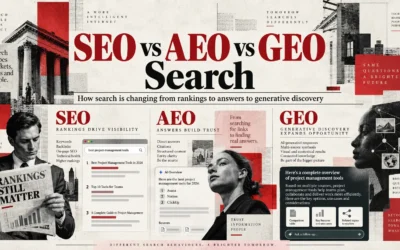
SEO vs AEO vs GEO Search: What the New Search Acronyms Actually Mean
Quick Answer: SEO helps people find your website through search engines like Google. AEO (answer engine optimization) helps your content become the direct answer inside featured snippets, voice search, and AI overviews. GEO (generative engine optimization) helps AI...

Claude vs ChatGPT vs Gemini vs Perplexity vs Grok
Quick Answer: If you only have time for one AI tool, pick ChatGPT for daily productivity, Claude for long-form writing that sounds human, and Perplexity when you need stats with sources. Gemini earns its keep inside the Google ecosystem, and Grok is best for real-time...

