
Keyword Research Tips
How to Find Keywords That Still Bring Traffic and Sales
In this guide
- What Is Keyword Research?
- What Search Volume, Keyword Difficulty, and Search Intent Really Tell You
- Why Long Tail Keywords Bring In Better Buyers
- The Keyword Research Process: A Step-by-Step Guide to Keyword Research
- Keyword Research for AI Search
- My Favorite Keyword Research Tools
- What I See Go Wrong in Keyword Research
- Last-Minute Advice Before You Start Your Keyword Research
- FAQs About Keyword Research
Key takeaways
- Most keywords are tiny. Almost 93% of US keywords get fewer than 10 searches a month. Small sites win in that space.
- Search volume is an estimate. Google Keyword Planner overestimated volume for 91% of keywords in one Ahrefs test.
- Clicks are harder to earn. About 68% of US Google searches now end without a click.
- Google still sends the traffic. It sends roughly 190 times as many visits to websites as ChatGPT does.
- AI search runs on longer questions. Google AI Mode queries average about 7 words. Classic searches average 4.
- Intent beats volume. In one study, bottom-of-funnel posts converted 25 times better than top-of-funnel posts.
Picture a small online store that sells women’s running shoes. The owner does what most guides tell her to do. She opens a keyword tool and picks the biggest number she can find: “shoes for women.” After months of work, she finally reaches page one.
Traffic goes up. Sales don’t.
The people searching “shoes for women” wanted heels, work flats, and sandals. She only sells running shoes. So they land on her site and leave within seconds.
Now picture her going after “women’s trail running shoes with a wide toe box” instead. The tool shows almost no searches. But every person who types that phrase is a runner with a specific problem. Her shop solves it. She gets fewer visitors and a lot more orders.
That gap between traffic and sales is what keyword research is really about. It isn’t a hunt for big numbers. It’s about learning the words your buyers use when they’re ready to act.
I’ve done keyword research services for law firms, stone suppliers, ecommerce shops, and cybersecurity companies. This guide shares the keyword research tips I use on real projects. Every stat is linked to its source so you can check it yourself.
What Is Keyword Research?
Keyword research is the process of finding the words and phrases people type into search engines. You study those search terms, figure out what each person wants, and decide which ones your website should target.
Think of it as market research with receipts. A survey tells you what people say they want. Keyword research shows you what they actually type when nobody is watching.
SEO keyword research and paid search research use the same data. Their goals are different, though. Paid ads chase keywords that convert today. SEO looks for keywords you can rank for and hold for years.
How AI search changed the way people search
What has changed is how often a search ends in a click. About 68% of US Google searches now end without one. People get their answer on the results page and move on.
AI Overviews add to this. Ahrefs found a 58% lower click-through rate for the top result when an AI Overview appears. A Pew Research study found the same pattern on the user side. People clicked a result on 8% of visits that showed an AI summary. Without one, they clicked on 15%.
Not every study is this gloomy. The Semrush AI Overviews study tracked the same keywords before and after AI Overviews showed up. Their zero-click rate didn’t rise. It dipped slightly.
Here’s my take. Keyword research matters more now. You have fewer clicks to fight for, so you can’t waste them on keywords that don’t fit your business. And when a keyword you want triggers an AI Overview, learn how to rank in AI Overviews instead of giving up on it.
What Search Volume, Keyword Difficulty and Search Intent Really Tell You
Every keyword tool shows you the same few numbers. They look precise. Most of them are educated guesses, and knowing that changes how you use them.
Search volume data is a guess, not a forecast
Search volume is the average number of times people search a term each month. It’s the first number everyone looks at. It’s also the least reliable.
Ahrefs compared Google Keyword Planner with real Search Console data. Planner overestimated 91% of keywords in the test, and more than half of those were way off. Google also shows rounded annual averages and lumps similar keywords together. So a keyword that peaks in December can look steady all year.
Other keyword research tools build their numbers from clickstream data and models. They’re useful. They’re still estimates.
Use search volume to compare keywords. Don’t use it to predict how much traffic you’ll get.
Keyword difficulty scores mostly count links
Keyword difficulty is a score from 0 to 100. It estimates how hard it is to reach the first page. Most tools base it on how many sites link to the pages already ranking.
That’s helpful, but it leaves a lot out. It doesn’t know how much your site has already published on the topic. It doesn’t check whether the ranking pages match what searchers want.
Time matters too. Ahrefs found that the average top-10 page is over two years old. Only 5.7% of pages reached the top 10 within a year of being published. If your site is new or small, start with low-difficulty keywords that fit your offer. Then earn links over time with a proper link-building guide as your playbook.
Search intent decides what kind of page ranks
Search intent is the reason behind a search. Google has gotten very good at reading it. It ranks the page type that best fits that reason.
| Intent | What the searcher wants | Example | Page type that ranks |
| Informational | To learn something | how to clean white running shoes | Guide or how-to post |
| Commercial | To compare before buying | best trail running shoes for flat feet | Comparison or review |
| Transactional | To buy now | buy women’s trail running shoes online | Product or category page |
| Navigational | To reach a specific site | Strava login | The brand’s own page |
Ahrefs learned this the hard way. Its backlink checker page used to be a sales page with a free trial offer. But people searching “backlink checker” wanted a tool they could use right away. So Ahrefs turned the page into a free, working tool. It ranked #1 almost overnight, and monthly traffic grew from about 14,000 to nearly 200,000 visits.
The same Ahrefs study found that 96.55% of pages get zero traffic from Google. A mismatch with intent is one of the most common reasons I see in audits. If this part is new to you, start with my guide on matching search intent.
One page can rank for hundreds of keywords
Here’s something most beginners miss. You don’t need one page per keyword. Ahrefs found the average #1 page also ranks fornearly 1,000 other keywords.
That’s why judging a keyword by its own volume can mislead you. A better question is how much traffic the top page gets from all its keywords combined. Ahrefs calls this traffic potential. Their research also shows that even the #1 spot rarely captures more than 30% of search volume for a single keyword.
So look at the page that ranks first and check its total traffic. That number is a better guide than any single keyword’s volume.
Keyword relevance is the number no tool gives you
Go back to the shoe store. “Shoes for women” scores well on volume. It fails on relevance, and no tool will warn you about that.
Relevance comes down to one question. If someone searched this and landed on my page, would they find what they wanted? If the answer is no, the keyword isn’t worth it at any volume. Online shops feel this the most, which is why relevance sits at the heart of any good ecommerce SEO strategy.
Why Long Tail Keywords Bring In Better Buyers
Long tail keywords are longer, more specific search terms. “Running shoes” is a head term. “Women’s trail running shoes with a wide toe box” is long tail. Fewer people search it, but the people who do know exactly what they want.
The long tail is also where almost all keywords live. Ahrefs found that almost 93% of keywords in the US get fewer than 10 searches a month. Backlinko’s study of 306 million keywords found something similar. Long tail queries made up 91.8% of all keywords but only 3.3% of total search volume.
That last number trips people up. If each long tail keyword brings so little traffic, why bother? The answer is that one page rarely ranks for just one of them. A good page ranks for dozens or hundreds of related long tail phrases. Together, they add up.
Ahrefs’ own blog shows this. Its guide on “submit domain to search engines” targets a keyword with about 10 searches a month. Yet the page pulls in around 3,800 visits a month from all the variations people use.
Long tail keywords are also much easier to rank for. Take “link building.” It has a keyword difficulty score of 87 in Ahrefs. Now add two words. Link building for roofers scores 0. Same topic, a fraction of the competition, and a far clearer buyer.
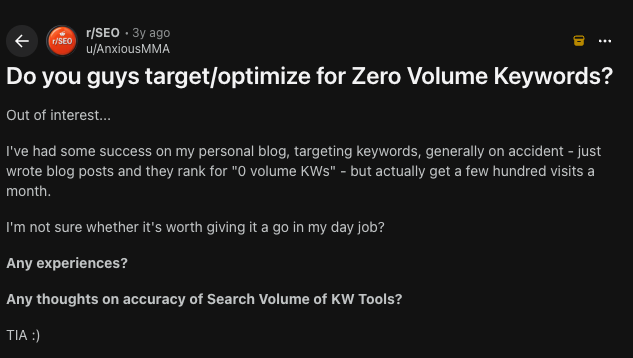
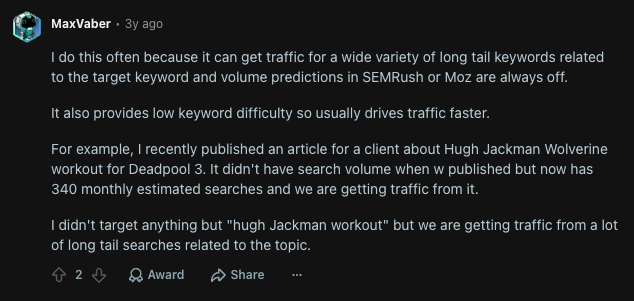
The money side is even more convincing. Grow and Convert tracked one software client’s blog posts by funnel stage. Bottom-of-funnel posts converted at 4.78%. Top-of-funnel posts converted at 0.19%. That’s about 25 times better for the posts written around buying intent.
A quick word of caution. Some people now treat every zero-volume keyword like hidden treasure. That goes too far. A keyword with no searches and no buyer behind it is still a dead end. Use long-tail keywords when real customers ask those questions. Your sales calls and support inbox will tell you which ones they are.
This is why I push long-tail keywords hard in SEO for small businesses. You don’t need to outrank big brands on their own terms. You just need to own the specific questions your buyers ask.
Not sure which keywords are worth chasing? I'll show you where to start.
The Keyword Research Process: A Step-by-Step Guide to Keyword Research
Ask ten SEOs how they do keyword research, and you’ll get ten answers. One of the top Google results for this topic is a Reddit thread full of them.
The process below is the one I follow for client sites. It works whether you sell shoes, legal services or software.
Step 1: Start with your business goals and target audience
Before you open any tool, write down two things. First, which pages make you money? These are usually service pages, product pages, and contact pages. Second, who buys from you, and what problem are they trying to solve?
Your keyword strategy should serve those money pages first. Blog content comes next, and its job is to answer questions that lead people toward them.
Step 2: Build a seed keyword list from real customer language
A seed keyword is a broad starting term. For our shoe store, seeds might be “trail running shoes,” “wide running shoes,” and “running shoes for bunions.”
The best seeds don’t come from tools. They come from your customers. Read your sales emails, support tickets, and reviews. Read your competitors’ reviews too. Customers describe problems in their own words, and those words often become your best keywords.
Step 3: Mine Google autocomplete, People Also Ask, and related searches
Google hands you keyword suggestions for free. Start typing a seed keyword in the search bar and Google autocomplete fills in what people commonly search next.
Then run the search and scroll. The People Also Ask box shows the questions searchers ask around your topic. It’s everywhere, too. One study of 1.2 million keywords found People Also Ask on about 78% of desktop results. At the bottom of the page, “People also search for” gives you even more related keywords.
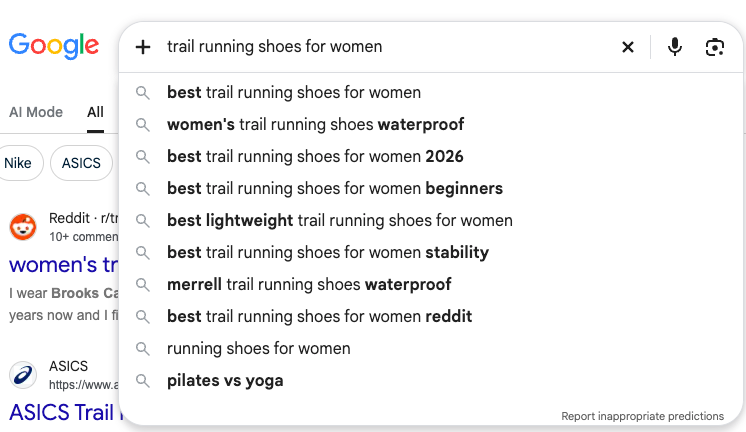
These are real search terms from real people. Save the ones that match what you sell.
Step 4: Find new keywords in Google Search Console
If your site is already live, Google Search Console is the best keyword tool you have. It’s free, and it shows the exact queries people used to find you.
Go to Performance, then Search results. Turn on impressions, clicks and average position. Then look for two things. The first is queries with lots of impressions but few clicks. Your page shows up, but your title isn’t earning the click. The second is queries where you rank in positions 8 to 20. You’re close to page one, and a small update can push you over.
One limitation to note is that the Search Console interface only shows your top 1,000 queries. For bigger sites, export the data or connect it to a reporting tool.
Pair this with Google Analytics to see which landing pages actually turn visitors into leads. Good SEO and analytics reporting connect the two, so you know which keywords drive buyers and which only drive browsers.
Step 5: Run a keyword gap analysis against competitors
A keyword gap analysis shows the keywords your competitors rank for that you don’t. It’s one of the fastest ways to find valuable keywords you’d never think of on your own.
Pick three competitors that rank for your topics. These may not be your business rivals. A local plumber’s real search competitors are often directories and big home-improvement blogs.
In Semrush, use the Keyword Gap tool. In Ahrefs, use Content Gap. Enter your site and your competitors, then filter for keywords where they rank and you don’t. Look for terms with clear buying intent first.
This is the same method I use in a full competitive content analysis. The gaps tell you what to write. The competitor pages tell you how much depth Google expects.
Step 6: Check Google Trends for timing and rising topics
Search volume is an average. Google Trends shows you the shape behind it. Type in a keyword and you’ll see whether interest is growing, fading, or seasonal.
This matters more than most people think. Ahrefs tracked “NotebookLM” averaging about 73,000 searches a month over a year. In a couple of peak months, it passed 400,000. A yearly average hides that spike completely.
For seasonal keywords, timing is everything. Publish your page a few months before the peak. Google needs time to find it and rank it.
Step 7: Read the search engine results pages before you commit
Never choose a keyword without searching it yourself. The search engine results pages tell you what Google thinks the searcher wants.
Look at who ranks. Are they product pages, guides, tools or forums? If page one is all product pages, a blog post will struggle. Check whether an AI Overview sits at the top, since that can cut clicks. Note any videos, map packs or shopping results pushing organic links down.
Forums are worth a special look. Reddit grew from 132 million to 346 million monthly visitors in less than a year as Google began ranking it more often. When Reddit ranks for your keyword, people want real opinions. Your content should give them first-hand experience too.
Step 8: Group multiple related keywords and pick one focus keyword per page
By now you have a long list. Don’t give every keyword its own page. Group multiple related keywords that share the same intent, and give that group one page.
“Trail running shoes for women” and “best women’s trail runners” belong together. “How to clean trail running shoes” is a different intent, so it gets its own page.
Each page then gets one focus keyword. That’s the main term for your title, URL, and first heading. The rest of the group goes in naturally where it fits.
This also keeps two of your pages from chasing the same keywords. When that happens, Google can’t tell which page to rank, and both suffer. If you suspect it’s happening already, here’s how to fix duplicate content.
Step 9: Prioritize with a simple scoring table
You can’t create content for every keyword at once. So score each group and start at the top.
Here’s a simple scoring table you can copy. Rate relevance, intent, and business value from 1 to 3. Then add keyword difficulty and traffic potential from your tool.
Keyword group | Intent | Relevance (1 to 3) | Business value (1 to 3) | Keyword difficulty | Traffic potential | Priority |
women’s trail running shoes wide toe box | Transactional | 3 | 3 | 8 | 900 | High |
best trail running shoes for flat feet | Commercial | 3 | 2 | 22 | 2,400 | High |
how to clean trail running shoes | Informational | 2 | 1 | 5 | 1,100 | Medium |
shoes for women | Mixed | 1 | 1 | 74 | 90,000 | Skip |
Example numbers for illustration only.
High relevance and high business value go first, even when traffic potential is lower. Volume only breaks ties.
Allstone, a natural stone supplier in Adelaide
Keyword Research for AI Search
More of your buyers now ask ChatGPT, Gemini, or Google’s AI Mode before they ever click a link. That doesn’t make keyword research useless. It means you need to research a little differently. Here are the tips I use for AI search.
Understand how AI changes the user’s search query
People talk to AI tools the way they’d talk to a person. Semrush found Google AI Mode queries average 7.22 words per query, compared with 4 words in classic search.
ChatGPT shows the same trend. Prompts that trigger a web search have nearly doubled in length, to an average of 8.7 words. Even more telling, 65% to 85% of those prompts matched no keyword in Semrush’s database at all.
And Google says about 15% of daily searches have never been seen before. Put those together and the lesson is clear. Your tools can’t see most of what people ask AI. You have to listen for it.
Collect questions, not just keywords
Start a running list of the exact questions your customers ask. Pull them from People Also Ask, Reddit threads, sales calls, and support emails. Write each one the way a real person would type it into ChatGPT.
A keyword might be “trail running shoes wide feet.” The prompt version sounds like this: “I have wide feet and run on rocky trails. Which women’s shoes won’t give me blisters?” Your page should answer that second version clearly.
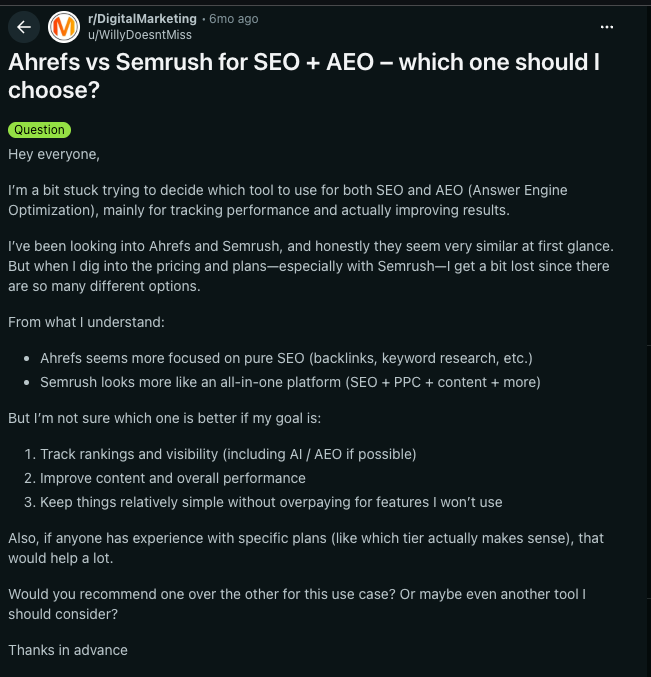
Break one big question into the smaller ones AI searches for
When you ask an AI tool a complex question, it often runs several searches behind the scenes. SEOs call this query fan-out.
Say someone asks, “What’s the best CRM for a 10-person dental clinic?” The AI might search for pricing, patient privacy rules, reviews, and setup time. Each of those is a smaller question. A page that answers all of them has a better chance of being cited than a page that answers only one.
So when you plan a page, list the follow-up questions a buyer would have. Then answer each one in its own short section.
Add the specific details AI looks for
AI tools love specifics. They match answers to details like location, industry, and team size. Price ranges and product names help too.
Compare “conveyancing lawyer” with “conveyancing lawyer in Adelaide with fixed fees.” The second one gives an AI tool something concrete to match. This tip matters most for local and service businesses. Add your city, your niche, and your real numbers to your pages.
Use ChatGPT for keyword ideas, not search volume
ChatGPT is great for brainstorming. Ask it for keyword ideas around a seed keyword, or ask it to group a messy list by intent. It saves hours.
Just don’t trust it for numbers. It will happily invent search volume figures that look real. Always check volume and difficulty in a proper keyword tool.
Check which prompts already mention you
Take your 10 most important buyer questions and run them in ChatGPT, Gemini and Perplexity once a month. Note which brands get named and which sources get cited. If competitors show up and you don’t, that’s your gap.
Bing Webmaster Tools has also started showing some data on AI citations. It’s early, but worth a look. I cover more methods in my guide to tracking brand mentions.
AI search is a big topic, and this section only covers the keyword side. For the full picture, read my pillar guide on SEO for LLMs. If the acronyms confuse you, start with SEO vs AEO vs GEO.
My Favorite Keyword Research Tools
There are hundreds of keyword research tools out there. I keep coming back to five. Each one does something the others don’t, and each one has a weak spot you should know about.
Ahrefs
Ahrefs is my go-to for judging whether a keyword is worth the fight. Its keyword difficulty scores and traffic potential numbers are the most useful I’ve found. I also use it to see every keyword a competitor ranks for, along with backlink analysis to understand why they rank.
The downside is price. For a single small-business site, it can be more of a tool than you need.
Semrush
Semrush is the most comprehensive SEO tool on this list. Its Keyword Magic Tool generates keyword ideas by the thousands, and its Keyword Gap tool compares your site against several competitors at once. It has also added features for tracking visibility in AI search.
The catch is that it does so much. Beginners can get lost in the menus before they find a single useful keyword.
Google Keyword Planner
Google Keyword Planner is free, and the data comes straight from Google. I use it to check commercial keywords and see what advertisers pay per click. A high cost per click usually means the keyword is profitable.
Its weakness is that it was built for ads, not SEO. Unless you run a Google Ads campaign, you’ll see broad volume ranges like “1K to 10K” instead of exact numbers.
Ubersuggest
Ubersuggest is a lighter, cheaper option. It gives you keyword suggestions, basic difficulty scores and content ideas in a simple layout. For a small business owner doing their own SEO, it’s a friendly place to start.
Its database is smaller than Ahrefs or Semrush. Treat its numbers as rough guides.
AnswerThePublic
AnswerThePublic turns one seed keyword into a map of the questions people ask about it. It’s my favorite tool for blog topics, and for building the prompt lists I mentioned in the AI section.
The free version only allows a few searches per day, so plan your searches before you start.
What about the free Google tools?
You’ll notice Google Search Console and Google Trends aren’t on this list. That’s only because I covered them in the process above. They’re still the free keyword research tools I’d open first on any project.
One last tip on tools. They often disagree with each other, sometimes by a lot.
So I never make a big decision from one tool’s numbers. I check them against real Search Console data first. If you’re on a tight budget, my list offree SEO tools will get you surprisingly far.
What I See Go Wrong in Keyword Research
Most of the sites I audit don’t have a content problem. They have a keyword problem. Good pages were built around the wrong terms, or around no clear term at all. These are the patterns that come up again and again.
“We want to rank for the big keyword”
This is the most common request I get. A law firm wants “lawyer.” A shoe store wants “shoes.” The number in the keyword tool looks exciting, so it feels like the obvious target.
But a keyword with extremely high search volume usually comes with three problems. Big brands already own it. An AI Overview often answers it before anyone clicks. And most people searching for it aren’t ready to buy from you.
The fix is to go a level deeper. “Conveyancing lawyer for first home buyers” will bring fewer visitors than “lawyer.” It will also bring the ones who call.
Writing for the keyword instead of the reader
Keyword stuffing is the old version of this mistake. People repeated the same phrase over and over, hoping Google would notice. Google noticed, and it stopped working years ago.
The modern version is quieter. Writers force an awkward phrase into every heading to hit a content tool’s score. The page ends up reading like it was written for a robot. Search engines now understand topics and meaning, so natural language wins.
Use your focus keyword where it fits naturally. Then write the rest for a human. My SEO writing tips go deeper on how to do both.
Two pages chasing the same keywords
This one sneaks up on growing sites. A blog post and a service page both target “keyword research services.” Or three blog posts all cover the same question from slightly different angles.
Google doesn’t know which page to rank, so it often ranks neither one well. The fix is the rule from Step 8. Give each intent one page, and merge or redirect the rest.
Doing keyword research once and never looking again
This is the mistake that costs the most over time. Search behavior changes, competitors publish, and Google updates its results. A keyword plan from two years ago is a snapshot of a market that has moved on.
The upside is that refreshing old pages works. HubSpot found that updating old blog posts lifted views by 106% on average. Backlinko relaunched one older post with new sections and examples. Its organic traffic grew 260.7% in 14 days.
Revisit your keyword research at least once a quarter. Check which pages are slipping and which new questions are showing up in Search Console. If you’re unsure where to start, here’s my guide on when to update content.
Last-Minute Advice Before You Start Your Keyword Research
If you only remember a few things from this guide, make it these.
Start with what you already have. Open Google Search Console today and find 10 queries ranked in positions 8-20. Those pages are close to page one. A better title or a stronger section could be all they need.
Trust your customers over your tools. If buyers keep asking the same question, write about it, even when the tool says nobody searches for it. Tools miss a lot. Your inbox doesn’t.
Keep it simple on the page. One page, one focus keyword, one intent. When you’re unsure, ask yourself what the searcher would expect to find if they clicked.
Put keyword research on your calendar. Once a quarter is enough for most small businesses. Markets shift, and your keyword list should shift with them.
And once you have your list, give it a plan. Keywords only pay off when they turn into pages people want to read. A clear SEO content strategy decides what gets written first. Good briefs keep every writer on target, which is why I offer content brief services for in-house teams.
Remember the shoe store from the start of this guide? Her winning keyword brought fewer visitors than “shoes for women” ever could. It also brought the right ones. That’s what good keyword research looks like.
Make Your Keyword Research Work for Google and AI Search
Nothing in this guide is a shortcut. Keyword research still comes down to knowing your buyers and the words they use. The tools only help you measure it. The businesses that win with keywords do three things. They pick terms that match what they actually sell. They give each search intent one strong page. They check their keywords against real Search Console data every quarter.
Start with the pages you already have. Most sites have pages sitting just outside page one. A sharper focus keyword and a clearer answer to the searcher’s question can be enough to move them up. That is what my content optimization services focus on.
Want a second pair of eyes on which keywords are worth your time? Send me your URL, and I will tell you where I would start.

Ready to turn keyword research into pages that sell?
FAQs About Keyword Research
Can I do keyword research for free?
What are the best keyword research tools?
How often should I do keyword research?
What is keyword stuffing?
What is the 80/20 rule in SEO?
What are the 3 C's of SEO?
Is SEO still worth it?
Yes. Google still sends about 190 times more traffic to websites than ChatGPT. Clicks are harder to earn, so picking the right keywords matters more than ever. You can see where search is heading in my roundup of the latest SEO trends.