
SEO Content Strategy
What It Takes to Rank, Get Cited, and Convert
Quick answer: An SEO content strategy is a documented plan for what you publish, who it’s for, and how each page helps you rank and convert. It connects keyword research and search intent to your business goals. A good strategy now targets two places at once. One is Google’s search results. The other is the AI answers that sit above them.
In this Guide:
Key takeaways
- A plan beats volume. Almost every B2B team has a content strategy. Very few say theirs works well.
- Rankings alone don’t pay the bills anymore. AI Overviews now take a big share of the clicks page one used to get.
- Audit before you create. Your fastest wins are often pages you already published.
- Clusters build authority. Topic clusters and smart internal linking show search engines you know a subject deeply.
- Track two scorecards. Measure how you show up in Google and how often AI answers cite you.
Here’s a number that still stings every time I share it. Ahrefs analyzed about 14 billion pages and found that 96.55% of them receive zero traffic from Google (Ahrefs search traffic study). Most content is never read by the person who searched for it.
The pages that do rank are working harder for fewer clicks. As of December 2025, AI Overviews cut clicks to the top-ranking page by 58% (Ahrefs AI Overviews study). That’s up from 34.5% in their first study eight months earlier.
I’ve been writing for the web since 2009. I started as a freelance writer and moved into search engine optimization because I kept asking why some posts were found, and others weren’t. After more than 15 years, the answer is simpler than most people expect. The brands that keep growing don’t publish more. They publish with a plan.
That plan is an SEO content strategy. This guide is the hub for everything I’ve written on the topic. You’ll learn what a strategy covers and how to build one step by step. You’ll also see how to measure it, plus three client campaigns with real numbers.
What Is an SEO Content Strategy?
An SEO content strategy is a documented plan for creating, organizing, and updating content so it ranks in search engines and supports your business goals.
Think of it as the bridge between two questions. What is your target audience searching for? And what do you want them to do once they find you?
The plan covers who you’re writing for and which topics you’ll own. It decides how pages link to each other and how you’ll measure success. Without it, you’re publishing blog posts one at a time and hoping some of them stick.
The payoff is better traffic. People who land on a page that matches their search are closer to buying. A good strategy shows up in leads and sales long before it shows up in a pretty traffic chart.
SEO Content Strategy vs. Content Marketing Strategy
The two overlap, but they answer different questions. Content marketing is the broader practice of using content to attract and retain customers across every channel. An SEO content strategy is the search-focused slice of that work. If you want the bigger picture, start with my content marketing strategy guide.
Content marketing strategy | SEO content strategy | |
Main goal | Build trust and awareness | Rank, get cited, and convert from search |
Channels | Email, social, events, video, search | Google search and AI answer engines |
Planning starts with | Brand story and audience needs | Search queries and user intent |
Main KPIs | Engagement, reach, pipeline | Search visibility, organic traffic, conversions |
Time to results | Varies by channel | Usually 3 to 6 months |
You need both. Content marketing gives your brand a voice. The SEO side makes sure people can actually find it.
What Does an SEO Content Strategist Do?
An SEO content strategist owns the plan. The job starts with conducting keyword research and reading the search intent behind each query. A good strategist doesn’t chase the biggest search volume. They look for topics the business can realistically win.
From there, they build the content calendar and write briefs for the team. They decide which existing content to update and which new pages to create. They also handle on-page optimization and track results in Google Search Console. When clients hire me for SEO content strategy services, that mix of planning and measuring fills most of my week.
Ranking Used to Be the Finish Line. Not Anymore.
For years, an effective SEO content strategy had one finish line. Get to page one, and the clicks would follow. That deal has changed, and the data is hard to ignore.
AI Overviews Are Shrinking Clicks From Google Search
Google’s AI Overviews now answer many questions right on the results page. Fewer people scroll down to the blue links.
Pew Research tracked the searches of 900 US adults. People clicked a regular result in 8% of visits when an AI summary appeared. Without one, that number was 15% (Pew Research Center study).
Seer Interactive found that organic click-through rates fell 61% on queries with an AI Overview (Seer Interactive CTR research). But the same study had a twist. Brands cited inside the AI Overview earned 35% higher organic click-through rates. Being the source still pays.
I’ve watched this play out across client accounts. Impressions keep climbing while clicks stay flat. I break down the mechanics in my guide on how AI Overviews affect SEO.
Wil Reynolds runs Seer Interactive, one of the best-known search agencies around. His lesson is one I share with clients all the time. Traffic is the wrong number to obsess over. Leads are what count.
Recent Core Updates Rewarded Depth Over Volume
Google’s March 2026 core update rolled out from March 27 to April 8. Google didn’t name specific targets. SEOs who studied the results still saw a clear pattern. Sites with deep coverage of one topic held up. Sites with thin posts across scattered topics slipped.
That matches what I see in audits. A site with 40 focused articles often beats a site with 200 random ones. If an update already hit you, here’s how to recover from core updates.
Most Businesses Have a Content Strategy. Few Have One That Works.
Content Marketing Institute’s latest B2B research found that 97% of marketers have a content strategy. Only about 1 in 8 call theirs highly effective (CMI 2026 trends research).
So having a plan isn’t the hard part. Running it is. Most strategies I review look great in a slide deck. They fall apart when nobody owns the calendar, and nobody updates old posts.
Search Visibility Now Lives in Two Places
Your content now needs to show up in two places. The first is Google’s search engine results pages. The second is the answers inside AI tools like ChatGPT, Perplexity, and Gemini.
Search Engine Land calls this a two-surface content strategy. Google still leans on links and technical signals. AI tools judge topical depth and credibility more directly. The good news is that most of the work overlaps. Clear structure and original insight help you win on both.
I cover the AI side in my pillar on SEO for LLMs. If the acronyms confuse you, start with SEO vs AEO vs GEO.
Not sure which pages still pull their weight?
The 5 Pillars of an Effective SEO Content Strategy
Every strategy I build rests on five pillars. Skip one and the other four get weaker.
1. Search Intent and Target Audience Alignment
Everything starts with the person on the other side of the search bar. Someone typing “what is SEO” wants to learn. Someone typing “SEO services pricing” is getting ready to buy. Same topic, very different needs.
Your content has to match the intent behind each query. If you’re fuzzy on the types of search intent, fix that first. Then build buyer personas from real conversations with customers and your sales team. Personas show you what people ask at each stage of buying.
2. Keyword Strategy and Topic Prioritization
Not every keyword deserves a page. Some have huge search volume but impossible competition. Others have modest volume but bring in buyers.
I like the lens Ahrefs uses for its own blog (Ahrefs’ prioritization framework). Each topic gets checked on three things. Business potential asks whether the topic connects to what you sell. Traffic potential asks whether enough people search for it. Ranking potential asks whether you can realistically reach the top spots.
Topics that score well on all three go to the top of your list. Then group relevant keywords into themes instead of chasing single phrases. That’s how you build authority on a subject.
3. Topic Clusters and Internal Linking
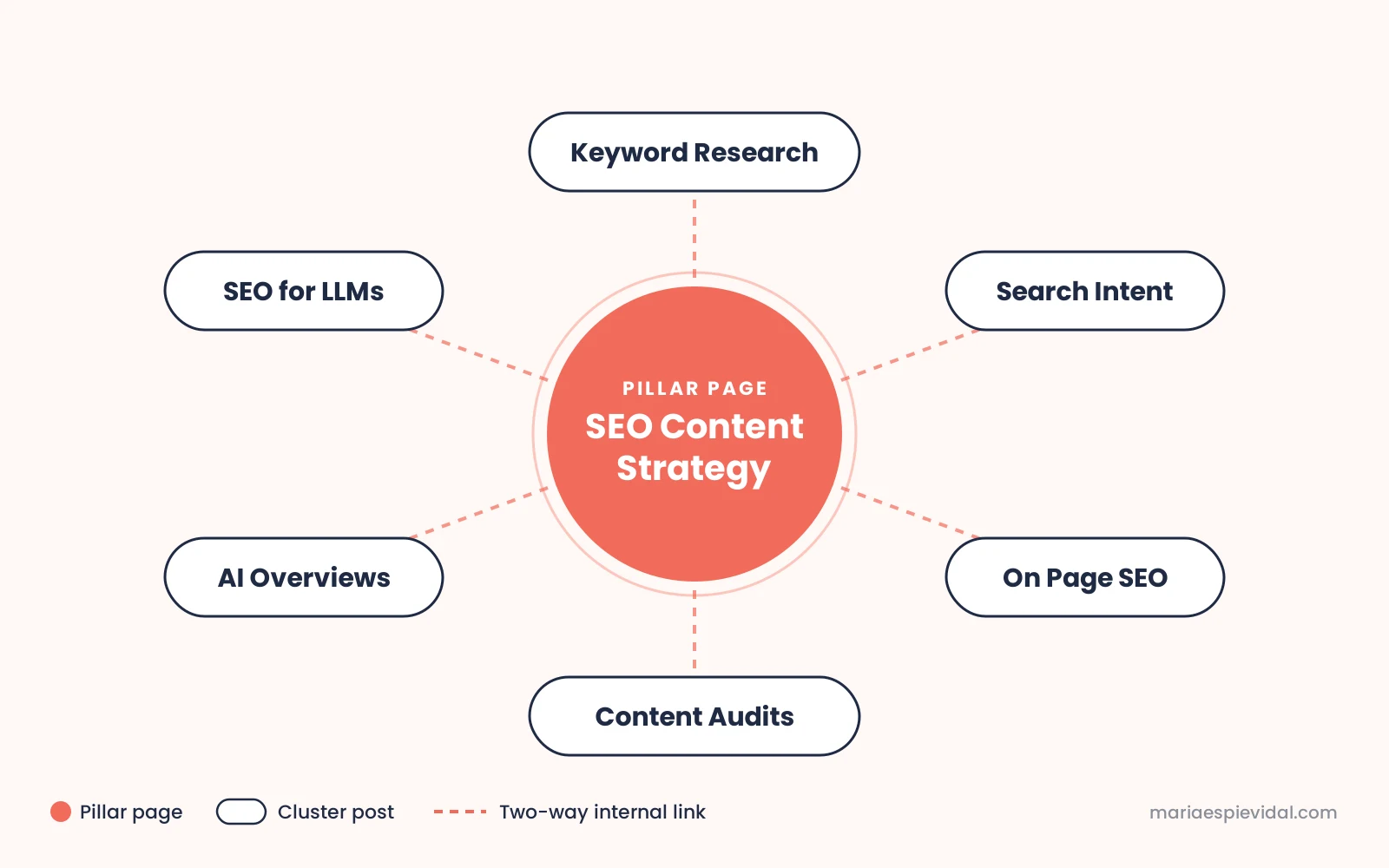
A topic cluster is a group of pages built around one theme. A pillar page covers the topic broadly. Supporting blog posts go deeper into each subtopic. Internal linking ties them together.
HubSpot made this model famous. Their blog had grown to around 14,000 posts, and their authority was spread thin. Regrouping those posts into clusters helped search engines understand what HubSpot actually knew.
Internal links do real work here. An Authority Hacker study of over a million sites found that good internal linking lifted rankings by up to 40%.
This page is a pillar too. Every guide I link from here belongs to its cluster.
4. High-Quality Content With Information Gain
Information gain is the new detail your page adds that other pages don’t (information gain explained). If your article says the same thing as the top five results, Google has no reason to rank it above them. AI tools have no reason to cite it either.
Lily Ray is one of the most trusted voices in SEO. In a 2026 expert roundup, she said the era of rewriting well-covered topics without new data or opinions is over (AI search expert roundup).
Information gain can come from your own data or client results. It can also be a strong opinion or a test you ran. It doesn’t have to be fancy. It has to be yours.
5. Measurement Across Search Engines and AI Answers
The last pillar keeps the other four honest. You need to know which pages bring traffic and which ones bring leads. Now you also need to know which pages AI tools cite. I cover the full setup in the measurement section below.
How to Build an SEO Content Strategy Step by Step
Here’s the process I use with clients. It works whether you’re starting from zero or fixing a site that’s been publishing for years.
Step 1: Define Business Goals and Key Performance Indicators
Start with what the business needs. Is it more demo requests? More calls from local customers? More trust before a big sale?
Pick one to three goals. Then attach one key performance indicator to each. If the goal is leads, your KPI might be form fills from organic search. If the goal is authority, it might be how often AI answers mention your brand. Write these down before you look at a single keyword.
Step 2: Audit Existing Content Before You Create Content
If your site has been around for a while, your fastest wins are already published. A content audit tells you which pages to keep and which ones to fix. It also shows which ones are holding you back.
Ahrefs once rewrote a page that had plenty of backlinks but almost no traffic. They matched it to search intent, and its traffic grew from about 14,000 to nearly 200,000 monthly visits. They didn’t build new links. They just gave searchers what they wanted.
Here’s the decision table I use on audits.
| What you see | What it means | What to do |
| Traffic and conversions | The page is doing its job | Keep it and review it twice a year |
| Traffic but no conversions | Wrong intent or a weak offer | Fix the call to action and the offer |
| Rankings slipping, outdated info | Coasting on old authority | Refresh facts, examples, and stats |
| Two pages on the same topic | Keyword cannibalization | Merge them into one stronger page |
| No traffic but good backlinks | Link value stuck on a weak page | Rewrite it or redirect it |
| No traffic, no links, 12+ months old | Dead weight | Remove it and redirect the URL |
Not sure how often to refresh? Here’s my take on when to update content. Overlapping pages are common too. Here’s how to fix duplicate content without losing rankings.
Step 3: Conduct Keyword Research Around Search Queries and User Intent
Keyword research is still the backbone of the job. Search Engine Land notes it takes up close to 20% of a strong SEO team’s week. That sounds like a lot until you see what happens when it’s skipped.
Start with seed terms your customers actually use. Plug them into Google Keyword Planner for free monthly search volume data. Then move to Semrush or Ahrefs for difficulty scores and related terms.
Don’t stop at tools. Reddit threads and People Also Ask boxes show you how real people phrase their problems. Those questions often make better headings than anything a tool suggests.
For a deeper walkthrough, grab my keyword research tips.
Step 4: Map Relevant Keywords to Content Types and Funnel Stages
Different searches need different formats. Look at what already ranks before you decide. If Google shows videos, a video may be your best shot. If comparison posts dominate, write a comparison.
| Funnel stage | What the searcher wants | Format that fits | Example query |
| Awareness | To understand a problem | Guides and explainers | What is an SEO content strategy |
| Consideration | To compare options | Comparisons and case studies | freelance vs in-house SEO |
| Decision | To pick a provider | Service and pricing pages | SEO content strategy services |
Mapping by stage keeps you from writing ten awareness posts and zero pages that sell. I go deeper on different content formats and how to plan sales funnel content in separate guides.
Step 5: Build Topic Clusters That Help Search Engines Understand Your Expertise
Now group your mapped keywords into clusters. Each cluster gets one pillar page and several supporting posts.
I follow a few simple rules. Every supporting post links back to the pillar near the top. The pillar links out to every supporting post. Related posts link to each other when it helps the reader. Descriptive anchor text helps search engines understand what each link points to.
How many posts does a cluster need? It depends on the topic. The Reddit practitioner above suggested 5 to 15 supporting pages, and that lines up with what I see on most small and mid-size sites. I explain the planning side in my content strategy framework.
Step 6: Write SEO Content That Adds Something New
This is where most strategies win or lose. Writers need direction. A good brief covers the target keyword and search intent. It also lays out the outline and internal links before anyone starts writing.
Then push for information gain. Add a client result or a screenshot from your own work. Open key sections with a short answer of 40 to 80 words. That format is easy for readers to scan and easy for AI tools to quote.
What about AI drafts? I use AI to speed up research and outlines. Every piece still gets a human edit for facts, voice, and fresh insight. Google cares more about quality than about how a draft started. I dug into whether Google penalizes AI content in a separate post.
Step 7: Nail On-Page SEO and Technical SEO Basics
Great content still needs a clean setup. On-page SEO tells search engines what each page is about. Technical SEO makes sure they can reach it at all.
Start with the page title. Put the main keyword near the front and keep it under 60 characters. Then write compelling meta descriptions that give people a reason to click. They don’t raise rankings directly, but they lift click-through rates.
Use one H1 and a clear H2 and H3 structure. Add image alt text that describes what’s actually in the image. Add structured data where it fits, like FAQ or article schema. Schema helps search engines understand your content and makes it easier for AI tools to parse.
On the technical side, watch your site speed and fix broken links. Make sure search engine bots can crawl and index your most important web pages. A slow site with crawl errors can sink even the best article.
Run through myon-page SEO checklist before every publish. For larger fixes, my technical SEO services include comprehensive audits and repairs.
Step 8: Earn Authority From Other Reputable Websites
Links from other reputable websites still matter. They build domain authority and help new pages rank faster.
The easiest links to earn come from content worth citing. Original data and case studies get linked to on their own. Rewritten listicles rarely do.
Eli Schwartz, author of Product-Led SEO, made a sharp point on LinkedIn this year. Companies spend thousands on backlinks with no clear way to measure them. Meanwhile, they ignore free links that already sit within reach.
My link-building guide walks through safe ways to earn links. Skip anything that involves buying them.
What a Successful SEO Campaign Looks Like: 3 Case Studies
Theory is nice. Results are better. Here are three campaigns where these steps did the heavy lifting.
Cybersecurity Brand: 492% More Sessions in Year Two
A Canadian cybersecurity and compliance company came to me in February 2023. They wanted to show up on Google without paying for ads. They also needed content that kept them credible in a crowded market.
We started with strategy, then rolled out new blog posts and service pages. Traction kicked in around July 2023. In year one, organic search sessions rose 38% and engaged sessions jumped 94%.
Year two is where the work compounded. Sessions grew 492% and new users grew 672%. Organic search now drives 60.24% of their total traffic. The gains held even after we paused new content for a few months due to budget. Read the full breakdown of this cybersecurity brand’s results.
Adelaide Natural Stone Supplier: Search Impressions Doubled
This Adelaide supplier sells granite, bluestone, and basalt. Their products were beautiful, but their website was nearly empty. Visitors bounced fast, and Google had little to rank.
We took over in early 2024. We fixed meta tags and site speed first. Then we built product content and filled gaps with blog topics based on buyer search queries.
Clicks in Google Search Console grew from 652 to 1,090. Impressions doubled from 15.9K to 32.1K. Organic search now brings in 46.3% of their Australian sessions. Those visitors also engage the most, with a 65.84% engagement rate. Here’s the full story of the natural stone supplier.
Facade Access Company: 267% Organic Traffic and #1 AI Visibility
This global brand makes building maintenance units and fall protection systems for high-rise buildings. When I took over in July 2025, they had eight websites. Every regional site was a copy of the global one. Not a single product had its own page.
We rebuilt the content during a site migration and the March 2026 core update. Every key product finally got a dedicated page. We also structured the blog posts and FAQs so that AI tools could parse and quote them.
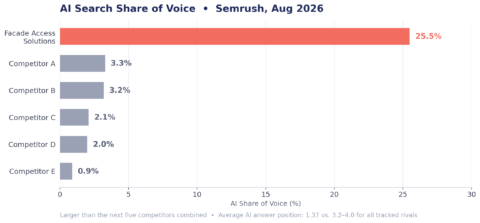
In 12 months, organic sessions rose 267%, from 357 to 1,311 a month. Impressions grew from 14.6K to 72.6K. The brand now holds 25.5% AI share of voice in its category. The nearest competitor sits at 3.3%. In July 2026, a quarter of the month’s form submissions came straight from ChatGPT and Gemini. See how it came together for this facade access company.
The Pattern Behind All Three
Different industries, same playbook. Each campaign started with an audit and a clear plan. Each one built clusters around what buyers searched for. And each one kept refreshing content instead of publishing and forgetting. You’ll see the same pattern in my grass supplier case study, where organic traffic grew by 937%. It also shows up in this wellness brand case study.
How to Measure SEO Content Strategy Success
A strategy without measurement is just a guess. Here’s what I track for every client.
Track Organic Traffic and Search Rankings in Google Search Console
Google Search Console shows how your pages appear in Google search. You’ll see impressions and clicks for each page. You’ll also see average position and the exact search queries behind them.
Watch the gap between impressions and clicks. Rising impressions with flat clicks often means an AI Overview is answering the query. That isn’t always bad news. You may need a sharper title, or a page strong enough to earn the citation.
Read User Engagement and Conversions in Google Analytics
Google Analytics tells you what happens after the click. Track organic traffic by landing page. Then check engagement rate and conversions for each one.
A page with traffic but no conversions usually has an intent problem or a weak offer. A page with few visits but strong conversions may deserve more internal links. My SEO analytics reporting setup ties these numbers to real leads.
Add AI Citations as Your Second Scorecard
Clicks from Google no longer tell the whole story. You also need to know when AI tools mention or cite your brand. Remember the Seer data from earlier. Cited brands get more organic clicks too, so this scorecard feeds the first one.
Ahrefs and Semrush both track brand mentions in AI answers now. GA4 can also show AI assistants as a referral source. I list the AI search visibility metrics worth watching in a separate guide. I also explain how to track brand mentions across platforms.
| Metric | Where to find it | What it tells you | How often |
| Impressions and clicks | Google Search Console | Search visibility and click appeal | Weekly |
| Average position for target keywords | Google Search Console or Semrush | Whether rankings are moving | Monthly |
| Organic sessions by landing page | Google Analytics | Which pages pull traffic | Monthly |
| Engagement rate and conversions | Google Analytics | Whether visitors take action | Monthly |
| AI mentions and citations | Ahrefs or Semrush | How often AI answers name you | Monthly |
| Referring domains | Ahrefs or Semrush | Growth in authority | Quarterly |
My Favorite Tools for Building an SEO Content Strategy
People ask what’s in my toolkit all the time. These are the tools I open almost every day. None of them replaces judgment, but together they save me hours each week.
Tool | What I use it for | Where it fits in my SEO process |
Google Search Console | Queries, impressions, and indexing issues | Audits and measurement |
Google Analytics | Engagement, conversions, and AI referrals | Measurement |
Semrush | Keyword research, position tracking, and site audits | Research and tracking |
Ahrefs | Backlinks, content gaps, and AI citation tracking | Research and authority |
SurferSEO | On-page scoring before I hit publish | Writing and optimization |
Claude | Briefs, first-draft help, and data analysis | Planning and writing |
ChatGPT | Topic ideas and outline brainstorming | Ideation |
Semrush and Ahrefs overlap a lot. I keep both because each one catches things the other misses. Semrush is my go-to for keyword research and tracking. Ahrefs is where I dig into backlinks and see how often AI answers mention a brand.
SurferSEO is my last stop before publishing. It compares a draft against top-ranking pages and flags missing topics. I treat its score as a guide, not a rule.
Claude and ChatGPT both have a place in my workflow, but they play different roles. Claude handles long briefs and messy data well. ChatGPT is faster for quick brainstorming. I put them head-to-head in my Claude vs. ChatGPT comparison.
If budget is tight, start with Google’s free pair and add paid tools later. Here’s my list of free SEO tools that still hold up.
Build It In-House or Bring In Help?
You have two paths. Both work if you commit to them.
Build it yourself. Use the steps in this guide. Audit your existing content and map your keywords. Then build one cluster at a time. This works if someone on your team has the time and patience to learn. Most strategies take months to pay off, so set expectations early.
Bring in a strategist. If your team is stretched thin, a strategist can run the plan while you run the business. You skip the learning curve and get a process already tested on real sites.
I also work with SEO and marketing agencies abroad that need extra hands. If that’s you, my white-label SEO support lets you deliver strategy under your own brand.
Turn Your SEO Content Strategy Into Pages That Rank and Get Cited
A strategy only works when someone runs it. Keyword research, topic clusters, and clean on page SEO still do most of the heavy lifting. What changed is the finish line. Your content now has to win a spot in Google’s results and earn a mention in the AI answers above them. The brands that grow through both do three things well. They audit before they publish. They build clusters around what buyers actually search for. They track leads and citations instead of traffic alone.
You don’t need to start from scratch. Most sites I review already have a handful of pages close to page one. A focused refresh can move those pages faster than any new post. That’s the first thing my content optimization services tackle.
Not sure where your strategy stands? Send me your URL, and I’ll point out the three pages I’d fix first.

Work directly with the strategist who builds and runs your plan.
FAQs About SEO Content Strategy
What is the difference between content marketing and an SEO content strategy?
How long does an SEO content strategy take to show results?
Most sites see real movement in three to six months. Updating pages that already rank can pay off within weeks. New sites with little authority take longer. My breakdown of how long SEO takes covers what speeds things up and what slows them down.
How many articles does a topic cluster need?
Does AI-written content hurt an SEO content strategy?
How much does an SEO content strategy cost?
It depends on your site’s size and how much content you need. A one-time strategy and audit costs less than ongoing writing and optimization. Here’s a fuller look at SEO marketing cost and what drives the price.